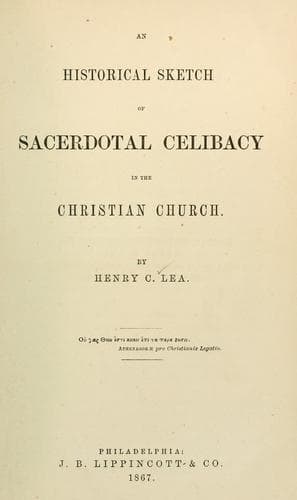
An Historical Sketch of Sacerdotal Celibacy in the Christian ChurchLea, Henry Charles
History
An Historical Sketch of Sacerdotal Celibacy in the Christian Church
Lea, Henry Charles
Catholic Church -- Clergy; Celibacy -- Catholic Church; Church history
The Eastern church thus formally and in the most solemn manner recorded
its separate and independent discipline on this point, and refused to
be bound by the sacerdotalism of Rome. It thus maintained the customs
transmitted from the early period, when asceticism had commenced to
show itself, but it shrank from carrying out the principles involved
to their ultimate result, as was sternly attempted by the inexorable
logic of Rome. The system thus laid down was permanent, for throughout
the East the Quinisext was received unquestioningly as a general
council, and its decrees were authoritative and unalterable. It is
true that in the confusion of the two following centuries a laxity
of practice gradually crept in, by which those who desired to marry
were admitted to holy orders while single, and were granted two years
after ordination during which they were at liberty to take wives, but
this was acknowledged to be an abuse, and about the year 900 it was
formally prohibited by a constitution of Leo the Philosopher.[177]
Thus restored, the Greek church has preserved its early traditions
unaltered to the present day. Marriage in orders is not permitted, nor
are digami admissible, but the lower grades of the clergy are free
to marry, nor are they separated from their wives when promoted to
the sacred functions of the diaconate or priesthood. The bishops are
selected from the regular clergy or monks, and, being bound by the vow
of chastity, are of course unmarried and unable to marry. Thus the
legislation of Justinian is practically transmitted to the nineteenth
century. Even this restriction on the freedom of marriage renders it
difficult to preserve the purity of the priesthood, and the Greek
church, like the Latin, is forced occasionally to renew the Nicene
prohibition against the residence of suspected women.[178]
The strongly marked hereditary tendency, which is so distinguishing a
characteristic of mediæval European institutions has led, in Russia at
least, since the time of Peter the Great, to the customary transmission
of the priesthood, and even of individual churches, from father to
son, thus creating a sacerdotal caste. To such an extent has this
been carried that marriage is obligatory on the parish priest, and
custom requires that the wife shall be the daughter of a priest. Some
of the results of this are to be seen in a law of 1867, forbidding
for the future the aspirant to a cure from marrying the daughter of
his predecessor or undertaking to support the family of the late
incumbent as a condition precedent to obtaining the preferment. It
shows how entirely the duties of the clergy had been lost in the sense
of property and hereditary right attaching to benefices, leading
inevitably to the neglect or perfunctory performance of ecclesiastical
duties.[179] We shall see hereafter how narrowly the Latin church
escaped a similar transformation, and how prolonged was the struggle to
avoid it.
* * * * *
Public-domain text, read in full here on John Shaqi.
Reviews
Reviews
No reviews yet
Be the first to share your thoughts on this work.
Elsewhere in the archive
Join the Discussion
Join the discussion
Sign in to leave a comment or review.
Sign InorCreate an account