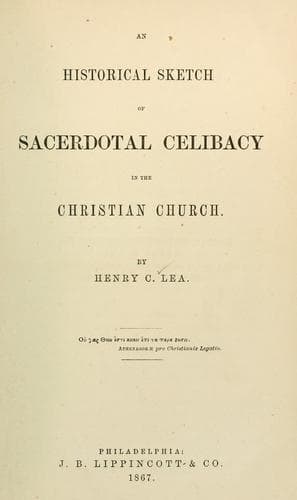
An Historical Sketch of Sacerdotal Celibacy in the Christian ChurchLea, Henry Charles
History
An Historical Sketch of Sacerdotal Celibacy in the Christian Church
Lea, Henry Charles
Catholic Church -- Clergy; Celibacy -- Catholic Church; Church history
The canons of the Quinisext are very full upon all the questions
relating to celibacy, and show that great relaxation had occurred in
enforcing the regulations embodied in the laws of Justinian. Digami
must have become numerous in the church, for the prohibition of their
ordination is renewed, and all who had not released themselves from
such forbidden unions by June 15th of the preceding year are condemned
to suffer deposition. So marriage in orders had evidently become
frequent, for all guilty of it are enjoined to leave their wives, when,
after a short suspension, they are to be restored to their position,
though ineligible to promotion.[172] A much severer punishment is,
however, provided for those who should subsequently be guilty of the
same indiscretion, for all such infractions of the rule are visited
with absolute deposition[173]—thus proving that it had fallen into
desuetude, since those who sinned after its restoration were regarded
as much more culpable than those who had merely transgressed an
obsolete law. Even bishops had neglected the restrictions imposed upon
them by Justinian, for the council refers to prelates in Africa, Libya,
and elsewhere, who lived openly with their wives; and although this is
prohibited for the future under penalty of deposition, and although all
wives of those promoted to the episcopate are directed to be placed
in nunneries at a distance from their husbands, yet the remarkable
admission is made that this is done for the sake of the people, who
regarded such things as a scandal, and not for the purpose of changing
that which had been ordained by the Apostles.[174]
With regard to the future discipline of the great body of the clergy,
the council, after significantly acknowledging that the Roman church
required a promise of abstinence from married candidates for the
diaconate and priesthood, proceeds to state that it desires to adhere
to the Apostolic canon by keeping inviolate the conjugal relations of
those in holy orders, and by permitting them to associate with their
wives, only stipulating for continence during the time devoted to the
ministry of the sacraments. To put an end to all opposition to this
privilege, deposition is threatened against those who shall presume
to interfere between the clergy and their wives, and likewise against
all who, under pretence of religion, shall put their wives away. At
the same time, in order to promote the extension of the church, in the
foreign provinces, this latter penalty is remitted, as a concession to
the prejudices of the “Barbarians.”[175] How thoroughly in some regions
sacerdotal marriage had come to be the rule we learn from a reference
to Armenia, where the Levitical custom of the Hebrews was imitated, in
the creation of a sacerdotal caste, transmitted from father to son, and
confined to the priestly houses. This limitation is condemned by the
council, which orders that all who are worthy of ordination shall be
regarded as eligible.[176]
Public-domain text, read in full here on John Shaqi.
Reviews
Reviews
No reviews yet
Be the first to share your thoughts on this work.
Elsewhere in the archive
Join the Discussion
Join the discussion
Sign in to leave a comment or review.
Sign InorCreate an account