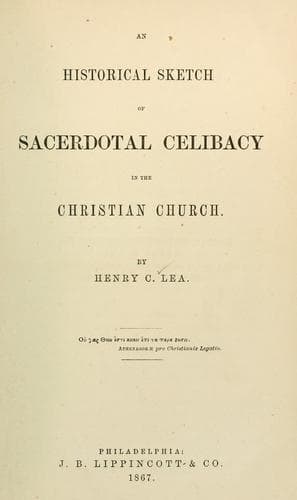
An Historical Sketch of Sacerdotal Celibacy in the Christian ChurchLea, Henry Charles
History
An Historical Sketch of Sacerdotal Celibacy in the Christian Church
Lea, Henry Charles
Catholic Church -- Clergy; Celibacy -- Catholic Church; Church history
This admirable plan may be considered the germ of the countless
associations by which the church has in all ages earned the gratitude
of mankind by giving to Christianity its truest practical exposition.
It combined a refuge for the desolate with a most efficient
organization for spreading the faith and administering charity; and
there was no thought of marring its utility by rendering it simply
an instrument for exaggerating and propagating asceticism. St. Paul,
indeed, expressly commands the younger ones to marry and bring up
children;[188] and he could little have anticipated the time when this
order of widows, so venerable in its origin and labors, would, by
the caprice of ascetic progress, come to be regarded as degraded in
comparison with the virgin spouses of Christ, who selfishly endeavored
to purchase their own salvation by shunning all the duties imposed
on them by the Creator.[189] Nor could he have imagined that, after
eighteen centuries, enthusiastic theologians would seriously argue that
Christ and his Apostles had founded regular religious orders, bound by
the three customary vows of chastity, poverty, and obedience.[190]
In the early church, as has been already shown, all vows of continence
and dedication to the service of God were a matter of simple volition,
not only as to their inception, but also as to their duration. The male
or female devotee was at liberty to return to the world and to marry
at any time;[191] although during the purer periods of persecution,
such conduct was doubtless visited with disapprobation and was attended
with loss of reputation. As, moreover, there was no actual segregation
from the world and no sundering of family ties, there was no necessity
for special rules of discipline. When, under the Decian persecution,
Paul the Thebæan, and shortly afterwards St. Antony, retired to the
desert in order to satisfy a craving for ascetic mortification which
could only be satiated by solitude, and thus unconsciously founded the
vast society of Egyptian cenobites, they gave rise to what at length
became a new necessity.[192] The associations which gradually formed
themselves required some government, and the institution of monachism
became too important a portion of the church, both in numbers and
influence, to remain long without rules of discipline to regulate
its piety and to direct its powers. As yet, however, a portion of
the church, adhering to ancient tradition, looked reprovingly on
these exaggerated pietistic vagaries. Lactantius, for instance, in a
passage written subsequent to the conversion of Constantine, earnestly
denounces the life of a hermit as that of a beast rather than of a man,
and urges that the bonds of human society ought not to be broken, since
man cannot exist without his fellows.[193]
Public-domain text, read in full here on John Shaqi.
Reviews
Reviews
No reviews yet
Be the first to share your thoughts on this work.
Elsewhere in the archive
Join the Discussion
Join the discussion
Sign in to leave a comment or review.
Sign InorCreate an account