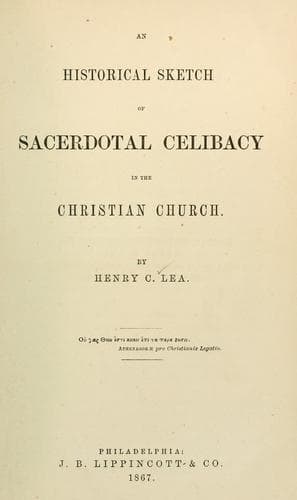
An Historical Sketch of Sacerdotal Celibacy in the Christian ChurchLea, Henry Charles
History
An Historical Sketch of Sacerdotal Celibacy in the Christian Church
Lea, Henry Charles
Catholic Church -- Clergy; Celibacy -- Catholic Church; Church history
It was in vain to attempt to stem the tide which had now fairly set in,
nor is it difficult to understand the impulsion which drove so many
to abandon the world. No small portion of pastoral duty consisted in
exhortations to virginity, the praises of which were reiterated with
ever increasing vehemence, and the rewards of which, in this world
and the next, were magnified with constantly augmenting promises.
Indeed, a perusal of the writings of that age seems to render it
difficult to conceive how any truly devout soul could remain involved
in worldly duties and pleasures, when the abandonment of all the ties
and responsibilities imposed on man by Providence was represented as
rendering the path to heaven so much shorter and more certain, and when
every pulpit resounded with perpetual amplifications of the one theme.
Equally efficacious with the timid and slothful was the prospect of
a quiet retreat from the confusion and strife which the accelerating
decline of the empire rendered every day wilder and more hopeless;
while the crushing burdens of the state drove many, in spite of all
the efforts of the civil power, to seek their escape in the exemptions
accorded to those connected with the church. When to these classes
are added the penitents—prototypes of St. Mary of Egypt, who retired
to the desert as the only refuge from her profligate life, and for
seventeen years waged an endless struggle with the burning passions
which she could control but could not conquer—it is not difficult to
estimate how vast were the multitudes unconsciously engaged in laying
the foundations of that monastic structure which was eventually to
overshadow all Christendom.[194] Indeed, even the church itself at
times became alarmed at the increasing tendency, as when the council
of Saragossa, in 381, found it necessary to denounce the practice of
ecclesiastics abandoning their functions and embracing the monastic
life, which it assumes was done from unworthy motives.[195]
Public-domain text, read in full here on John Shaqi.
Reviews
Reviews
No reviews yet
Be the first to share your thoughts on this work.
Elsewhere in the archive
Join the Discussion
Join the discussion
Sign in to leave a comment or review.
Sign InorCreate an account