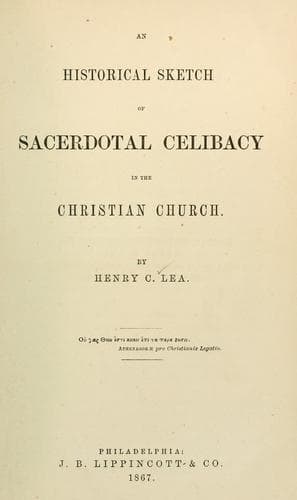
An Historical Sketch of Sacerdotal Celibacy in the Christian ChurchLea, Henry Charles
History
An Historical Sketch of Sacerdotal Celibacy in the Christian Church
Lea, Henry Charles
Catholic Church -- Clergy; Celibacy -- Catholic Church; Church history
History shows us how little obedience this also received, nor is it
probable that much more attention was paid to the imperial rescript
when, in 532, Justinian confirmed the legislation of his predecessors,
and added provisions forbidding those who had once taken the vows
from returning to the world under penalty of being handed over to the
_curia_ of their municipality, with confiscation of their property,
and personal punishment if penniless.[223] Had the effort then been
successful, he would not have been under the necessity of renewing it
in 535 by a law making over to the monastery, by way of satisfaction
to God, the property of any monk presuming to abandon a life of
religion and returning to the cares of the world.[224] The prevalent
laxity of manners is further shown by another provision according to
which the monk who received orders was not allowed to marry, even
if he entered grades in which marriage was permitted to the secular
clergy, the penalty for taking a wife or a concubine being degradation
and dismissal, with incapacity for serving the state.[225] Ten years
later, further legislation was found necessary, and at length the final
expedient was hit upon, by which the apostate monk was handed over
to the bishop to be placed in a monastery, from which if he escaped
again he was delivered to the secular tribunal as incorrigible.[226]
The trouble was apparently incurable. Three hundred and fifty years
later, Leo the Philosopher deplores it, and orders all recalcitrant
monks to be returned to their convents as often as they may escape. As
for the morals of monastic life, it may be sufficient to refer to the
regulation of St. Theodore Studita, in the ninth century, prohibiting
the entrance of even female animals.[227]
* * * * *
Thus gradually the irrevocable nature of monastic vows became
established in the East, more from reasons of state than from
ecclesiastical considerations. In the West, matters were longer
in reaching a settlement, and the causes operating were somewhat
different. Monachism there had not become a terror to the civil power,
and its management was left to the church; yet, if its influence was
insufficient to excite tumults and seditions, it was none the less
disorganized, and its disorders were a disgrace to those on whom rested
the responsibility.
Public-domain text, read in full here on John Shaqi.
Reviews
Reviews
No reviews yet
Be the first to share your thoughts on this work.
Elsewhere in the archive
Join the Discussion
Join the discussion
Sign in to leave a comment or review.
Sign InorCreate an account