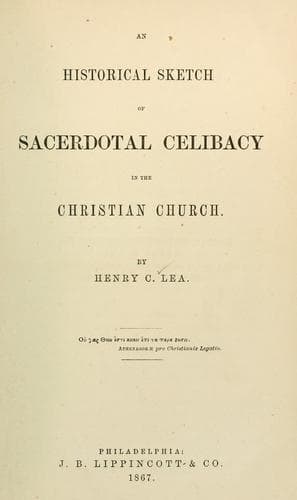
An Historical Sketch of Sacerdotal Celibacy in the Christian ChurchLea, Henry Charles
History
An Historical Sketch of Sacerdotal Celibacy in the Christian Church
Lea, Henry Charles
Catholic Church -- Clergy; Celibacy -- Catholic Church; Church history
became necessary to the peace of both church and state.
At the council of Chalcedon, in 451, the hierarchy had their revenge
for the insults which they had suffered two years before in the Robber
Synod. A large portion of the monks, infected with Eutychianism, came
into direct antagonism with the bishops, whom they defied. With the aid
of the civil power, the bishops triumphed, and endeavored to put an end
for the future to monastic insubordination, by placing the monasteries
under the direct control and supervision of the secular prelates. A
series of canons was adopted which declared that monks and nuns were
not at liberty to marry; but while excommunication was the punishment
provided for the offence, power was given to the bishops to extend
mercy to the offenders. At the suggestion of the Emperor Marcian,
the council deplored the turbulence of the monks who, leaving their
monasteries, stirred up confusion everywhere, and it commanded them to
devote themselves solely to prayer and fasting in the spot which they
had chosen as a retreat from the world. It forbade them to abandon
the holy life to which they had devoted themselves, and pronounced
the dread sentence of the anathema on the renegades who refused to
return and undergo due penance. No monastery was to be founded without
the license of the bishop of the locality, and he alone could give
permission to a monk to leave it for any purpose.[219]
This legislation was well adapted to the end in view, but the evil was
too deep-seated and too powerful to be thus easily eradicated. Finding
the church unable to enforce a remedy, the civil power was compelled to
intervene. As early as 390 Theodosius the Great had ordered the monks
to confine themselves strictly to deserts and solitudes.[220] Two years
later he repealed this law and allowed them to enter the cities.[221]
This laxity was abused, and in 466 the Emperors Leo and Anthemius
issued an edict forbidding for the future all monks to go beyond the
walls of their monasteries on any pretext, except the apocrisarii, or
legal officers, on legitimate business alone, and these were strictly
enjoined not to engage in religious disputes, not to stir up the
people, and not to preside over assemblages of any nature.[222]
Public-domain text, read in full here on John Shaqi.
Reviews
Reviews
No reviews yet
Be the first to share your thoughts on this work.
Elsewhere in the archive
Join the Discussion
Join the discussion
Sign in to leave a comment or review.
Sign InorCreate an account