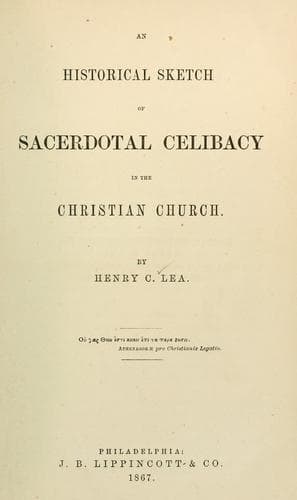
An Historical Sketch of Sacerdotal Celibacy in the Christian ChurchLea, Henry Charles
History
An Historical Sketch of Sacerdotal Celibacy in the Christian Church
Lea, Henry Charles
Catholic Church -- Clergy; Celibacy -- Catholic Church; Church history
A new apostle was clearly needed to aid the organizing spirit of Rome
in her efforts to regulate the increasing number of devotees, who
threatened to become the worst scandal of the church, and who could
be rendered so efficient an instrument for its aggrandizement. He was
found in the person of St. Benedict of Nursia, who, about the year 494,
at the early age of sixteen, tore himself from the pleasures of the
world, and buried his youth in the solitudes of the Latian Apennines.
A nature that could wrench itself away from the allurements of a
splendid career dawning amid the blandishments of Rome was not likely
to shrink from the austerities which awe and attract the credulous and
the devout. Tempted by the Evil Spirit in the guise of a beautiful
maiden, and finding his resolution on the point of yielding, with a
supreme effort Benedict cast off his simple garment and threw himself
into a thicket of brambles and nettles, through which he rolled until
his naked body was lacerated from head to foot. The experiment, though
rude, was eminently successful; the flesh was effectually conquered,
and Benedict was never again tormented by rebellious desires.[232]
A light so shining was not created for obscurity. Zealous disciples
assembled around him, attracted from distant regions by his sanctity,
and after various vicissitudes he founded the monastery of Monte
Casino, on which for a thousand years were lavished all that veneration
and munificence could accumulate to render illustrious the birthplace
and capital of the great Benedictine Order.
The rule promulgated by Benedict, which virtually became the
established law of Latin Monachism, shows the more practical character
of the western mind. Though pervaded by the austerest asceticism, yet
labor, charity, and good works occupy a much more prominent place in
its injunctions than in the system of the East. Salvation was not
to be sought simply by abstinence and mortification, and the innate
selfishness of the monastic principle was relaxed in favor of a broader
and more human view of the duties of man to his Creator and to his
fellows. This gave to the institution a firmer hold on the affections
of mankind and a more enduring vitality, which preserved its fortunes
through the centuries, in spite of innumerable aberrations and
frightful abuses.
Public-domain text, read in full here on John Shaqi.
Reviews
Reviews
No reviews yet
Be the first to share your thoughts on this work.
Elsewhere in the archive
Join the Discussion
Join the discussion
Sign in to leave a comment or review.
Sign InorCreate an account