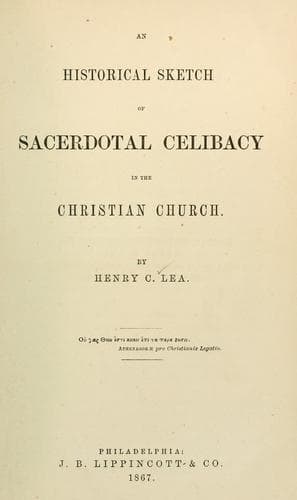
An Historical Sketch of Sacerdotal Celibacy in the Christian ChurchLea, Henry Charles
History
An Historical Sketch of Sacerdotal Celibacy in the Christian Church
Lea, Henry Charles
Catholic Church -- Clergy; Celibacy -- Catholic Church; Church history
Still there were as yet no irrevocable vows of poverty, chastity, and
obedience exacted of the novice. After a year of probation he promised,
before God and the Saints, to keep the Rule under pain of damnation,
and he was then admitted with imposing religious ceremonies. His
worldly garments were, however, preserved, to be returned to him in
case of expulsion, to which he was liable if incorrigibly disobedient.
If he left the monastery, or if he was ejected, he could return twice,
but after the third admission, if he again abandoned the order, he was
no longer eligible.[233] Voluntary submission was thus the corner-stone
of discipline, and there was nothing indelible in the engagement which
bound the monk to his brethren.
Contemporary with St. Benedict was St. Cæsarius of Arles, whose Rule
has been transmitted to us by his nephew, St. Tetradius. It is very
short, but is more rigid than that of Benedict, inasmuch as it requires
from the applicant the condition of remaining for life in the convent,
nor will it permit his assumption of the habit until he shall have
executed a deed bestowing all his property either on his relatives or
on the establishment of his choice, thus insuring the rule of poverty,
and depriving him of all inducement to retire.[234]
The Rule of St. Benedict, however, overcame all rivalry, and was at
length universally adopted; Charlemagne, indeed, inquired in 811
whether there could be any monks except those who professed obedience
to it.[235] Under it were founded the innumerable monasteries which
sprang up in every part of Europe, and were everywhere the pioneers
of civilization; which exercised a more potent influence in extending
Christianity over the Heathen than all other agencies combined; which
carried the useful arts into barbarous regions, and preserved to modern
times whatever of classic culture has remained to us. If they were
equally efficient in extending the authority of the Roman curia, and in
breaking down the independence of local and national churches, it is
not to be rashly assumed that even that result was a misfortune, when
the anarchical tendencies of the Middle Ages were to be neutralized
principally by the humanizing force of religion, and consolidation
was requisite to carry the church through the wilderness. Until the
thirteenth century the Benedictines were practically without rivals,
and their numbers and holiness may be estimated by the fact that in the
fifteenth century one of their historians computed that the order had
furnished fifty-five thousand five hundred and five blessed members to
the calendar of saints.[236]
Public-domain text, read in full here on John Shaqi.
Reviews
Reviews
No reviews yet
Be the first to share your thoughts on this work.
Elsewhere in the archive
Join the Discussion
Join the discussion
Sign in to leave a comment or review.
Sign InorCreate an account