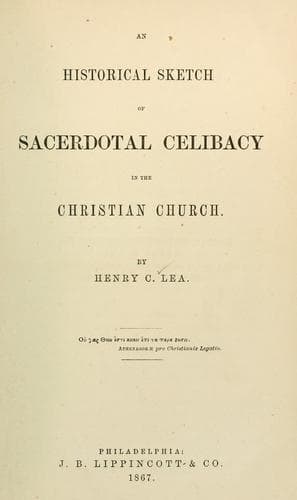
An Historical Sketch of Sacerdotal Celibacy in the Christian ChurchLea, Henry Charles
History
An Historical Sketch of Sacerdotal Celibacy in the Christian Church
Lea, Henry Charles
Catholic Church -- Clergy; Celibacy -- Catholic Church; Church history
The theory of perpetual segregation from the world was thus
established, and it accomplished at last the objects for which it
was designed, but it was too much in opposition to the invincible
tendencies of human nature to be universally enforced without a
struggle which lasted for nearly a thousand years. To follow out
in detail the vicissitudes of this struggle would require too much
space. Its nature will be indicated by occasional references in the
following pages, and meanwhile it will be sufficient to observe how
little was accomplished even in his own age by the energy and authority
of Gregory. It was only a few years after his death that the council
of Paris, in 615, proves to us that residence in monasteries was not
considered necessary for women who took the vows, and that the civil
power had to be invoked to prevent their marriage.[241] Indeed, it
was not uncommon for men to turn their houses, nominally at least,
into convents, living there surrounded with their wives and families,
and deriving no little worldly profit from the assumption of superior
piety, to the scandal of the truly religious.[242] St. Isidor of
Seville, about the same period, copies the words of St. Augustin
in describing the wandering monastic impostors who lived upon the
credulous charity of the faithful;[243] and he also enlarges upon the
disgraceful license of the _acephali_, or clerks bound by no rule,
whose vagabond life and countless numbers were an infamy to the western
kingdoms which they infested.[244] The quotation of this passage by
Louis-le-Débonnaire, in his attempt to reform the church, shows that
these degraded vagrants continued to flourish unchecked in the ninth
century;[245] and, indeed, Smaragdus, in his Commentary on the Rule
of St. Benedict, assures us that the evil had rather increased than
diminished.[246]
* * * * *
Public-domain text, read in full here on John Shaqi.
Reviews
Reviews
No reviews yet
Be the first to share your thoughts on this work.
Elsewhere in the archive
Join the Discussion
Join the discussion
Sign in to leave a comment or review.
Sign InorCreate an account