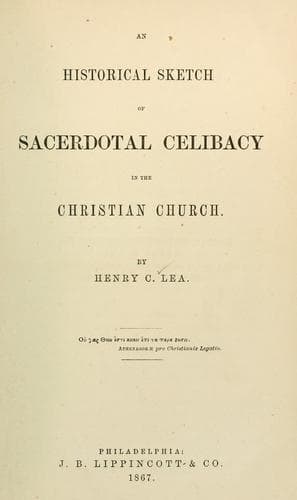
An Historical Sketch of Sacerdotal Celibacy in the Christian ChurchLea, Henry Charles
History
An Historical Sketch of Sacerdotal Celibacy in the Christian Church
Lea, Henry Charles
Catholic Church -- Clergy; Celibacy -- Catholic Church; Church history
Yet it could not but be a scandal to all devout minds that a man who
had once devoted himself to religious observances should return to the
world. Not only did it tend to break down the important distinction
now rapidly developing itself between the clergy and the laity, but
the possibility of such escape interfered with the control of the
church over those who formed so large a class of its members, and
diminished their utility in aiding the progress of its aggrandizement.
We cannot be surprised, therefore, that within half a century after
the death of St. Benedict, among the reforms energetically inaugurated
by St. Gregory the Great, in the first year of his pontificate, was
that of commanding the forcible return of all who abandoned their
profession—the terms of the decretal showing that no concealment had
been thought necessary by the renegades in leading a secular life
and in publicly marrying.[237] Equally determined were his efforts
to reform the abuses which had so relaxed the discipline of some
monasteries that women were allowed perfect freedom of access, and the
monks contracted such intimacy with them that they openly acted as
godfathers to their children;[238] and when, in 601, he learned that
the monks of St. Vitus, on Mount Etna, considered themselves at liberty
to marry, apparently without leaving their convent, he checked the
abuse by the most prompt and decided commands to the ecclesiastical
authorities of Sicily.[239]
By the efforts of Gregory the monk was thus, in theory at least,
separated irrevocably from the world, and committed to an existence
which depended solely upon the church. Cut off from family and friends,
the door closed behind him forever, and his only aspirations, beyond
his own personal wants and hopes, could but be for his abbey, his
order, or the church, with which he was thus indissolubly connected.
There was one exception, however, to this general rule. No married man
was allowed to become a monk unless his wife assented, and likewise
became a nun. The marriage-tie was too sacred to be broken, unless both
parties agreed simultaneously to embrace the better life. Thus, on the
complaint of a wife, Gregory orders her husband to be forcibly removed
from the monastery which he had entered and to be restored to her.
We shall see hereafter how entirely the church in time outgrew these
scruples, and how insignificant the sacrament of marriage became in
comparison with that of ordination or the vow of religion.[240]
Public-domain text, read in full here on John Shaqi.
Reviews
Reviews
No reviews yet
Be the first to share your thoughts on this work.
Elsewhere in the archive
Join the Discussion
Join the discussion
Sign in to leave a comment or review.
Sign InorCreate an account