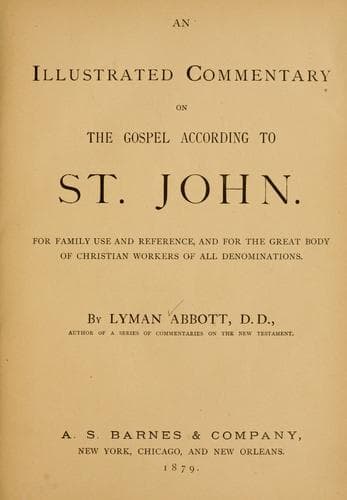
An illustrated commentary on the Gospel according to St. JohnAbbott, Lyman
Religion
An illustrated commentary on the Gospel according to St. John
Abbott, Lyman
Bible. John -- Commentaries
=36. He that believeth on the Son hath everlasting life.= An
assertion, not a promise. The declaration is not that everlasting life
shall be given to him in the future as a reward for his act of faith,
but that faith at once inducts him into spiritual life, which is alone
everlasting. Compare ver. 18 above; Rom. 6:23; 1 John 3:2. Observe
what faith confers is _life_, _i. e._, the highest development and
activity of the whole being (John 10:10), the reverse being
death.--=He that believeth not the Son.= Two different Greek words are
translated in the two clauses of this verse by the English word
_believe_. The force of the original is impaired, if not destroyed, by
this mistranslation; but it is not easy to find in English the exact
equivalent for the distinction which is noted in the original. The
passage may perhaps be rendered, _He that hath faith in_ (πιστεύων
εἰς) _the Son hath everlasting life; but he that will not be persuaded
by_ (ἀπειθων) _the Son shall not see life_. Beware of considering
_Believe on the Son_ as equivalent to either _Believe correctly about
the Son_, or even _Believe the Son_. See Matt. 18:6, note.--=Shall not
see life.= Not only shall not have it, but cannot even comprehend it.
Spiritual life is only spiritually discerned, and faith is the first
condition of spiritual discernment. See ver. 3 and note.--=The wrath
of God abideth on him.= Remains, as something previously resting upon
him and not removed. See Ephes. 2:3.
[Illustration: SYCHAR.]
CHAPTER IV.
Ch. 4:1-26. CHRIST AND THE WOMAN OF SAMARIA.--CHRIST A PREACHER
IN SEASON AND OUT OF SEASON.--HIS EXAMPLE AS A CHRISTIAN
CONVERSATIONALIST.--THE DIVINE SPRING; THE HUMAN CISTERN.--THE
ESSENTIAL AND THE INSIGNIFICANT QUESTIONS IN WORSHIP CONTRASTED.
This interview between Christ and the Samaritan woman is reported
alone by John. The time is uncertain; the only definite indication is
that of verse 35, and the interpretation of that is uncertain. With
Ellicott and Andrews, I think December of A. D. 27 the most probable
date. Matthew (4:12) explains Christ’s departure into Galilee by
saying that it took place when he heard that John the Baptist was cast
into prison; John here attributes it to another cause, a fear of
rivalry and contention between his own and John’s disciples. The
probable explanation is that Christ left Judea for the latter reason,
but did not commence his public ministry till the imprisonment of the
Baptist. See ch. 5, Prel. note.
1 When therefore the Lord knew how the Pharisees had heard
that Jesus made and baptized[124] more disciples than John,
[124] ch. 3:22, 26.
2 (Though Jesus himself baptized not, but his disciples,)
3 He left Judæa, and departed again into Galilee.
4 And he must needs[125] go through Samaria.
[125] Luke 2:49.
Public-domain text, read in full here on John Shaqi.
Reviews
Reviews
No reviews yet
Be the first to share your thoughts on this work.
Elsewhere in the archive
Join the Discussion
Join the discussion
Sign in to leave a comment or review.
Sign InorCreate an account