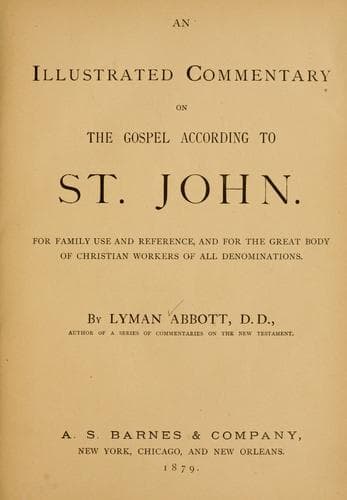
An illustrated commentary on the Gospel according to St. JohnAbbott, Lyman
Religion
An illustrated commentary on the Gospel according to St. John
Abbott, Lyman
Bible. John -- Commentaries
=1-4. Jesus made and baptized more disciples than John.= The
conversation between Christ and Nicodemus took place at the Passover,
and therefore in the spring; if that between Christ and the woman at
the well occurred in December, Jesus and John the Baptist baptized
together during the summer. The doctrine which Christ preached at this
time was substantially the same as that of the Baptist. “Repent, for
the kingdom of heaven is at hand” (Matt. 3:2; 4:17); for he had not
yet begun to explain publicly the spiritual and universal nature of
his kingdom. But differences between the ministries of the two were
from the first apparent; differences chiefly respecting the
ceremonials of religion--purifying, baptizing, fasting (ch. 3:25, 26;
Matt. 9:14). The increasing popularity of Christ threatened to awake
the envy of the Baptist’s disciples, his disregard of ceremonial to
awaken their suspicion; the Pharisees were alert to stimulate both. So
Christ withdrew, forestalling the first danger of rupture and
conflict, a lesson to all Christian workers against all unchristian
rivalries and contentions about details in doctrine or ceremony. Envy
is the most common instigator of denominational controversy.--=Jesus
himself baptized not.= No instance is recorded of any baptism
administered by Christ, or of any baptism commanded or authorized by
Christ, till after his resurrection and about the time of his
ascension. Baptism appears to have been adopted by his disciples from
John the Baptist, and employed by them without express direction from
Christ, as a symbol of repentance and a profession of a new life, and
to have been subsequently adopted in a modified form by their Lord.
That it was always regarded by the apostles as subordinate to the
preaching of the Word is indicated by Acts 10:4, 8, with 1 Cor. 1:16,
17, from which it appears to have been a ministerial act not
ordinarily performed by the apostles. On the history of baptism, see
note on the baptism of Jesus by John, Vol. I, p. 72, and on Christian
baptism, note on Matt. 28:19.--=And he must needs go through Samaria.=
Simply because that province lay directly between Judea and Galilee,
and therefore on the direct route. See map. Josephus tells us that it
was the custom of the Galileans, when they came to the holy city to
the festivals, to take their journey through the country of the
Samaritans. The more bigoted Judeans may have sometimes avoided it by
going through Perea. The history of Samaria explains, and in some
measure justifies, the odium attaching to it and its inhabitants among
the Jews. At the time of the secession of the ten tribes under
Rehoboam (1 Kings, ch. 12), Shechem was adopted by him as the capital
of the new monarchy, and made the seat of an idolatrous worship.
Subsequently the city of Samaria was built by Omri, king of Israel, as
capital (1 Kings 16:24), and so remained till the time of the
captivity of the ten tribes under Shalmaneser (2 Kings 17:6). A
Public-domain text, read in full here on John Shaqi.
Reviews
Reviews
No reviews yet
Be the first to share your thoughts on this work.
Elsewhere in the archive
Join the Discussion
Join the discussion
Sign in to leave a comment or review.
Sign InorCreate an account