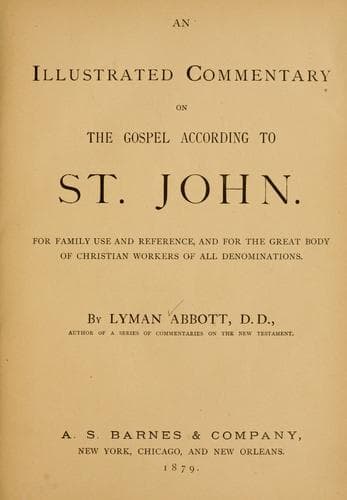
An illustrated commentary on the Gospel according to St. JohnAbbott, Lyman
Religion
An illustrated commentary on the Gospel according to St. John
Abbott, Lyman
Bible. John -- Commentaries
=7, 8. A woman of Samaria.= That is, a Samaritan woman.--=To draw
water.= In the East the towns are not supplied, as with us, by means
of aqueducts and water-pipes, nor are individual houses furnished each
with its well. The well itself is usually excavated from the solid
limestone rock, and provided with a low curb to guard against accident
(Exod. 21:33). On such a curb Christ probably sat to rest. The well is
ordinarily not furnished with any apparatus for drawing water. Each
woman brings her own bucket, most commonly made of the skin of some
animal; sometimes the well is shallow, and she descends by steps made
for the purpose (Gen. 24:16), and dips the water up from the surface;
if it is deep, she lets down her bucket with a rope. To assist in the
work, a wheel or pulley is sometimes fixed over the well. A trough of
wood or stone usually provides a means for watering cattle and sheep
(Gen. 24:20; Exod. 2:16). In this case, Christ had no bucket with him,
and the well being deep, so that he could not descend into it, he had
no means of obtaining water (ver. 11).--=Jesus saith unto her, Give me
to drink.= Observe how insignificant a request he makes the occasion
for a deeply spiritual religious conversation; and how natural the
transition from the material to the spiritual. Observe, too, that by
asking a favor he opens the way to the granting of one. He thus
verifies the truth that the way to gain another’s good will is not at
first by _doing_, but by _receiving_ a kindness.--=His disciples were
gone ... to buy meat.= They apparently carried little or nothing to
eat on their journeys (Matt. 16:6, 7; 12:1), but money to make the
necessary purchases (John 12:6). The direction to depend on
hospitality (Matt. 10:9, 10) was not for their general guidance and
government.
9 Then saith the woman of Samaria unto him, How is it that
thou, being a Jew, askest drink of me, which am a woman
of Samaria? for the Jews have no dealings[127] with the
Samaritans.
[127] Acts 10:28.
=9. For the Jews have no dealings with the Samaritans.= This is
taken by some to be said by the woman; more probably it was added
parenthetically by the Evangelist, to explain to his Gentile readers
the woman’s surprise. For the reason of the fact, see on verse 4. It
seems clear that the statement is not to be taken literally, for the
disciples, who were Jews, had just gone into the Samaritan city to
purchase food; but that there was abundant ground for it is evident
from Rabbinical writings; _e. g._, “Let no Israelite eat one mouthful
of anything that is a Samaritan’s; for if he eat but a little mouthful,
he is as if he ate swine’s flesh.”
10 Jesus answered and said unto her, If thou knewest the
gift[128] of God, and who it is that saith to thee, Give
me to drink; thou wouldest have asked of him, and he would
have given thee living[129] water.
[128] Eph. 2:8.
Public-domain text, read in full here on John Shaqi.
Reviews
Reviews
No reviews yet
Be the first to share your thoughts on this work.
Elsewhere in the archive
Join the Discussion
Join the discussion
Sign in to leave a comment or review.
Sign InorCreate an account