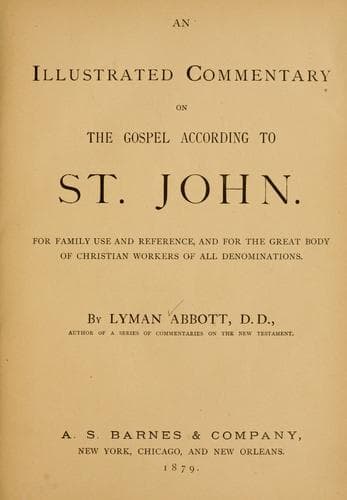
An illustrated commentary on the Gospel according to St. JohnAbbott, Lyman
Religion
An illustrated commentary on the Gospel according to St. John
Abbott, Lyman
Bible. John -- Commentaries
[129] Isa. 12:3; 41:17, 18; Jer. 2:13; Zech. 13:1;
14:8; Rev. 22:17.
=10. If thou knewest the gift of God.= Not, If thou knew that water is
the gift of God; this knowledge might indeed have prevented her
seemingly surly refusal, but it would not have led her to ask living
water of him. Nor, If thou knewest the peace and joy which are the
spiritual gifts of God; these constitute the living water, and if she
already knew them, in her experience, she would not need to ask to
_receive_ them. Christ is the unspeakable gift of God; if she knew the
full importance of this gift, the office and work of the Messiah, and
that he who was asking her for a drink of water was he, she would have
asked and received from him living water. The objection that the woman
would not have so comprehended the reference, and therefore that it
cannot be the primary meaning (_Alford_, _Meyer_), is not tenable,
because by the very language itself it is implied that the woman will
not comprehend it. Christ speaks of a mystery to provoke her to
further inquiry.--=Living water.= This phrase signifies primarily
spring water, as opposed to water in a cistern. In Gen. 26:19; Lev.
14:5; Jer. 2:13, the word rendered “springing,” “running,” and
“living,” is in the Septuagint the one here rendered “living.” It is
taken by Christ as a symbol of the spiritual life which he imparts,
and so as a symbol of himself, for he gives himself to the soul, and
is, by his indwelling, the bread and water of life. The spiritual
meaning then is not _life-giving_; for that a different Greek word
would be employed (ζωοποιών not ζῶν). It is true that living water is
life-giving, but that is not the meaning conveyed by the phrase. The
meaning is water that has life in itself, as in John 6:51; “living
bread” means the living Christ, in contrast with the inert manna. The
significance of the metaphor here is explained by its connection.
Christ compares himself with water, not because of its cleansing
power, nor because of its revivifying power on the soil, but because
he satisfies the soul’s thirst. A similar metaphorical use of water is
to be found in the O. T. See Psalm 23:2; Isaiah 55:1; Jer. 2:13; but
especially Numb. 20:8-11, an incident which it appears to me probable
Christ had in mind, and one with which the woman was probably
familiar, as the Samaritans accepted and employed the Pentateuch.
Observe that salvation is the gift of God (Rom. 6:23), and that the
only condition of receiving it is asking (Matt. 5:6; 7:7; Rev. 22:17).
The water’ is always ready; it is the thirst only that is wanting
(Luke 14:17-19).
11 The woman saith unto him, Sir, thou hast nothing to draw
with, and the well is deep: from whence then hast thou that
living water?
12 Art thou greater than our father Jacob, which gave us
the well, and drank thereof himself, and his children, and
his cattle?
Public-domain text, read in full here on John Shaqi.
Reviews
Reviews
No reviews yet
Be the first to share your thoughts on this work.
Elsewhere in the archive
Join the Discussion
Join the discussion
Sign in to leave a comment or review.
Sign InorCreate an account