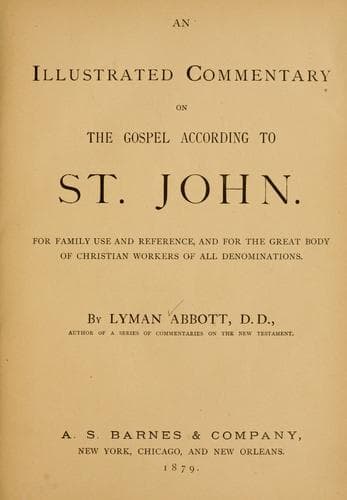
An illustrated commentary on the Gospel according to St. JohnAbbott, Lyman
Religion
An illustrated commentary on the Gospel according to St. John
Abbott, Lyman
Bible. John -- Commentaries
fountain will be transformed, but the duration of its existence; it
will forever spring up in the soul. The contrast throughout these
verses is between earthly and spiritual supplies. The _well_ (φρέαρ)
is a symbol of earthly supply. This appeases but never satisfies; for
it furnishes that which is external, and which is consumed in the
using, so that the soul which relies on earthly cisterns for its
satisfaction thirsts again. The living water, the spring (πηγή) which
Christ gives, becomes a fountain in the soul, it enters into and
becomes part of the character; using does not consume but increases
the supply. In Christ’s promise here thirst is not equivalent to
“desire,” nor is the declaration “shall never thirst,” equivalent to
“shall never feel any spiritual want.” Thirst is of all bodily
cravings the most painful and intolerable. Hence it is used in the
Bible as a metaphor, not merely of spiritual _desires_, but of an
urgent and intense desire, that cannot be denied (Psalm 42:2; 63:1;
143:6; Isaiah 55:1; Matt. 5:6, note). Here then the declaration is
that Christ satisfies this painful longing, so that the soul shall
experience it no more. Of soul-thirst we have striking illustrations
in Psalms 41 and 42, and in Rom. 7:17-24; of soul-satisfaction in
Christ, illustrations in Psalm 46 and in Rom. 8:31-39. Compare
Christ’s promises in John 11:36; 16:32, 33. The continuance of earnest
spiritual desires is not inconsistent with a rich spiritual
experience. See Phil. 3:12-14.
15 The woman saith unto him, Sir, give me this water, that
I thirst not, neither come hither to draw.
=15.= There is certainly a difference in tone between this request
and the answer of verses 11, 13. The woman now dimly recognizes and
vaguely appreciates Christ’s interpretation of her own soul-want, and
replies half in jest, half in earnest. But her language “neither come
hither to draw,” shows that she still gives to Christ’s words, as I
think purposely misinterpreting them, a prosaic and literal meaning.
Observe the implied misapprehension of the office of Christ, as one
who relieves the soul of all further care and labor in the matter of
religion. “There are many like her who would be glad of such a divine
gift of religion as should take away all the labor and trouble of
Christian life. ‘That I come not hither to draw’ is the desire of
thousands who want the results of right living without the trouble of
living aright.”--(_H. W. Beecher._)
16 Jesus saith unto her, Go, call thy husband, and come
hither.
Public-domain text, read in full here on John Shaqi.
Reviews
Reviews
No reviews yet
Be the first to share your thoughts on this work.
Elsewhere in the archive
Join the Discussion
Join the discussion
Sign in to leave a comment or review.
Sign InorCreate an account