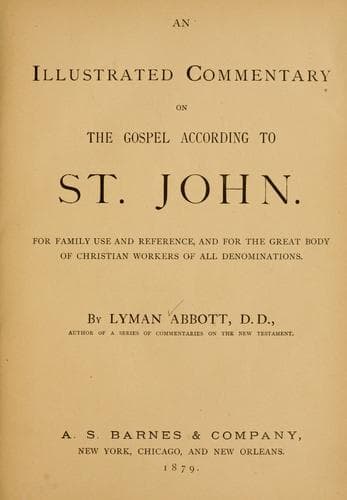
An illustrated commentary on the Gospel according to St. JohnAbbott, Lyman
Religion
An illustrated commentary on the Gospel according to St. John
Abbott, Lyman
Bible. John -- Commentaries
=16. Go, call thy husband=, etc. This is in appearance a break in the
conversation; it is in reality the first step toward granting the
woman’s request: “Give me this water;” for the first step is to
convince of sin. It is only if we confess our sins that “He is
faithful and just to forgive us our sins and to cleanse us from all
unrighteousness” (1 John 1:9). Hence when Christ came to bring this
water of life to the world he began by preaching the duty of
repentance (Matt. 4:17; Mark 1:15). Other explanations, as that a
longer conversation with the woman alone would be indecorous
(_Grotius_), or that she was unable to understand Christ’s meaning and
so he summoned her husband (_Cyril_, quoted in _Alford_), or that he
wished her husband to share with her in the benefits of the
conversation (_Chrysostom_), singularly ignore the moral meaning and
continuity of the discourse. Observe Christ’s uniform way of dealing
with skepticism. Its root is in sin; and he addresses not the reason,
but proceeds directly to convict the conscience. It is only the
sinner, conscious of sin, who ever truly finds a divine Saviour.
17 The woman answered and said, I have no husband.Jesus
said unto her, Thou hast well said, I have no husband:
18 For thou hast had five husbands; and he whom thou now
hast is not thy husband: in that saidst thou truly.
=17, 18.= The word (ἀνήρ) in Christ’s reply, rendered _husband_, is one
of more general import and is often translated _man_. But it is the
ordinary word used in the N. T. for husband, and I see no reason to
doubt that she had lived with five successive husbands.--From these
she had been separated, from some perhaps by death, from others by
divorce; at all events the last of these separations was unconcealedly
illegal, and her present life was one which her own conscience
condemned as licentious. Observe the severity in fact and the
gentleness in form of Christ’s rebuke. It shows a full knowledge of
her sin; yet it is couched in the language not of condemnation but of
commendation.
19 The woman saith unto him, Sir, I perceive[133] that thou
art a prophet.
[133] ch. 1:48, 49.
20 Our fathers worshipped in this mountain;[134] and ye
say, that in Jerusalem[135] is the place where men ought to
worship.
[134] Judges 9:7.
[135] Deut. 12:5-11; 1 Kings 9:3.
Public-domain text, read in full here on John Shaqi.
Reviews
Reviews
No reviews yet
Be the first to share your thoughts on this work.
Elsewhere in the archive
Join the Discussion
Join the discussion
Sign in to leave a comment or review.
Sign InorCreate an account