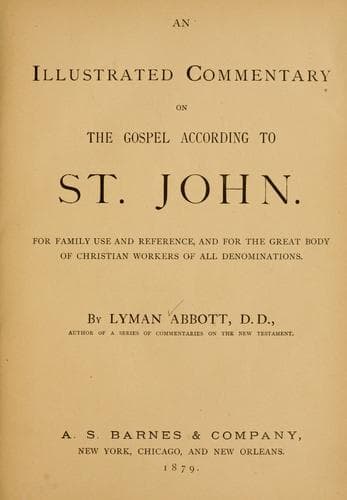
An illustrated commentary on the Gospel according to St. JohnAbbott, Lyman
Religion
An illustrated commentary on the Gospel according to St. John
Abbott, Lyman
Bible. John -- Commentaries
=34. For me meat is in order that I may do the will of him that sent
me.= The meaning is not, as our English version seems to imply, that
meat and doing God’s work are synonymous. The above is a literal
translation of the original; and the meaning is, The object of meat is
that I may do the will of him that sent me and may finish his work.
The expression is parallel to and interpreted by Paul’s in Acts 20:24,
“Neither count I my life dear unto myself so that I might finish my
course;” or in Phil. 1:21, “For to me to live is Christ.” The object
of Christ was the accomplishment of his mission; for this purpose
alone had meat any value to him; for this purpose he both needed and
possessed meat that his disciples, in their then state of spiritual
culture, did not and could not understand; and in the work which he
had accomplished, by his conversation with the woman, he had received
greater satisfaction than in any food which they could have brought to
him from the city.
35 Say not ye, There are yet four months, and _then_
cometh harvest? behold, I say unto you, Lift up your eyes,
and look on the fields; for they are white already to
harvest.[144]
[144] Matt. 9:37.
=35.= There is some uncertainty regarding the proper interpretation
of this verse. Alford, Tholuck, De Wette, and some others, suppose
that Christ is quoting a proverbial expression; perhaps referring
to the time which elapsed between seed-time and harvest, perhaps
to some time intervening between a local feast or a religious
anniversary and the harvest. Meyer, Andrews, Ellicott, and others
take it as a chronological indication that it was then four months
to harvest, _i. e._, the month of December, a fact to which perhaps
some reference had been made by the disciples in the course of
their walk. Chrysostom, Meyer, and others, suppose moreover that
the approaching Samaritans were seen through the corn-fields, and
to them Christ pointed when he said, “Lift up your eyes and look on
the fields.” “The approaching townspeople now showed how greatly
the doing of the Father’s will was in process of accomplishment.
They were coming through the corn-field, now tinged with green;
thus they make the fields, which for four months would not yield
the harvest, in a higher sense already white harvest fields. Jesus
directs the attention of his disciples to this; and with the beautiful
picture thus presented in nature he connects further appropriate
instructions.”--(_Meyer._) The phrase “Say not ye” seems to me clearly
to indicate that Christ refers to some proverbial saying (comp. Matt.
16:2); the direction, “Lift up your eyes and look on the fields,”
indicates some present appearance which gave point to his declaration
that they were white already, a declaration which would have no
significance if the fields were literally ready for the harvest. I
therefore, with Tholuck, combine the two views and suppose that Christ
Public-domain text, read in full here on John Shaqi.
Reviews
Reviews
No reviews yet
Be the first to share your thoughts on this work.
Elsewhere in the archive
Join the Discussion
Join the discussion
Sign in to leave a comment or review.
Sign InorCreate an account