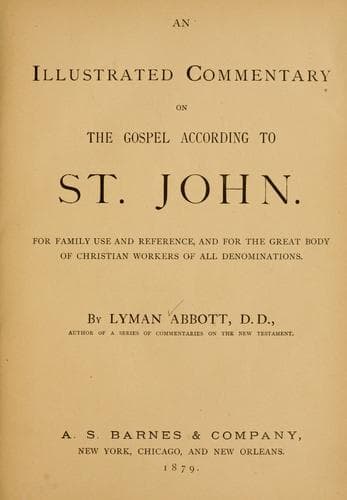
An illustrated commentary on the Gospel according to St. JohnAbbott, Lyman
Religion
An illustrated commentary on the Gospel according to St. John
Abbott, Lyman
Bible. John -- Commentaries
33 Therefore said the disciples one to another, Hath any
man brought him _aught_ to eat?
=31-33. Master, eat.= The disciples had brought food from the city, to
obtain which they had originally left him (ver. 8).--=I have meat to
eat that ye know not of.= The commentators generally assume that the
doing of his Father’s will was this meat. This seems to me a false
interpretation not required by and not really accordant with a correct
reading of ver. 34 below (see note there); inconsistent with other
teachings of Scripture, and practically misleading to the disciple.
It is inconsistent with the metaphor; for in nature work is never
a substitute for food, but physiologically exhausts it. It is
inconsistent with other teachings of Scripture, which never represent
_work_, but always divine sustaining grace, as the Christian food. It
is practically misleading, for it leads the disciple to suppose that
he can grow by simply doing the will of his Father, whereas he is to
acquire the power to do that will by constantly receiving grace from
the Father. Christ’s language here is interpreted by such passages as
Matt. 4:4, “Man shall not live by bread alone, but by every word that
proceedeth out of the mouth of God;” Matt. 25:4, “The wise took oil in
their vessels with their lamps.” Compare John, ch. 6. That Jesus lived
by this divine food is evident from his habit of prayer, and from such
declarations as John 5:19, 26, 30; 14:10, 11. This meat then is the
indwelling Spirit of God, conditioned upon entire consecration to God.
It was this meat which fed Peter in prison (Acts 12:6), Paul and Silas
at Philippi (Acts 16:25), and Paul in the shipwreck (Acts 27:23,
etc.); this too which sustained Christ in the hour of Gethsemane and
throughout his Passion. A faint type of it is afforded in earthly
experiences by the strength which seems often to be imparted to even a
feeble mother in the hour of her child’s sickness, and which carries
her through vigils which, but for her love, it would be impossible for
her to sustain. Her work is not her food: her love and faith are her
food, and sustain her for her work. No Christian can live by or on his
work; nor did Christ.--=Hath any one brought him aught to eat.=
They thought, perhaps, that the woman had done so. “It is very
characteristic of the first part of this Gospel to bring forward
instances of unreceptivity to spiritual meaning. Compare ver. 11; ch.
2:20; 3:4; 6:42, 52.”--(_Alford._)
34 Jesus saith unto them, My meat[142] is to do the will of
him that sent me, and to finish[143] his work.
[142] ch. 6:38; Job 23:12.
[143] ch. 17:4.
Public-domain text, read in full here on John Shaqi.
Reviews
Reviews
No reviews yet
Be the first to share your thoughts on this work.
Elsewhere in the archive
Join the Discussion
Join the discussion
Sign in to leave a comment or review.
Sign InorCreate an account