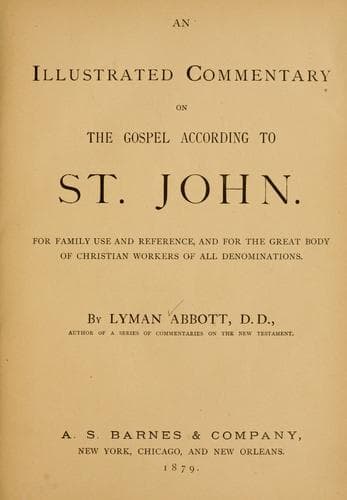
An illustrated commentary on the Gospel according to St. JohnAbbott, Lyman
Religion
An illustrated commentary on the Gospel according to St. John
Abbott, Lyman
Bible. John -- Commentaries
53 So the father knew that _it was_ at the same[157] hour,
in the which Jesus said unto him, Thy son liveth: and
himself believed,[158] and his whole house.
[157] Ps. 107:20.
[158] Acts 16:34; 18:8.
54 This _is_ again the second miracle _that_ Jesus did,
when he was come out of Judæa into Galilee.
=50-54. He went his way.= The course of the nobleman was not that of
one deficient in faith. On the contrary, he did not wait to see signs
or wonders; he believed the simple word. That he did not hasten is
evident from the next verse. Christ spoke the word of healing at the
seventh hour, _i. e._, one in the afternoon. The father could have
reached home that same night; but it was not until the next day that
his servants, coming to relieve his fears, met him on the road. Faith
neither worries nor hurries.--=Thy son is living.= He was so sick
before the father left home, that the mere announcement that he was
living demonstrated that he was recovering. The case was one in which
life could not last long if a change for the better did not take
place.--=Himself believed.= Believed what? He had believed before,
when he came to Jesus, or he would not have come; and again when he
went away, or he would not have been satisfied at the mere word of
Jesus. But he before simply believed _about_ Jesus, _e. g._, that he
was a prophet, possessing certain healing powers, the extent of which
he had not measured. Now he believed _on_ Jesus; without as yet
comprehending the Saviour’s mission or character, he yet had faith in
him; that kind of faith which was ready to accept him as all that he
claimed, whatever that might be. To _believe_, used absolutely, as
here, always indicates not believing a doctrine about Christ, but
personal belief in and allegiance to him.
This miracle is certainly not the same with the healing of the
centurion’s servant, recorded in Matt. 8:5-13, with which it has been
sometimes confounded, but with which it really has little in common.
One is wrought at Capernaum, the other at Cana; one at the petition of
a nobleman, an officer of the court, the other at the request of a
centurion; one probably for a Jew, the other certainly for a Roman;
one in behalf of a son, the other in behalf of a servant; one for a
petitioner who entreats Christ to come to his house, the other for one
who deprecates his doing so; one affording an illustration of the
largest faith in a heathen, the other of the development of faith from
a small beginning in an Israelite. The resemblances are superficial;
the differences are radical. Accepting the narrative as true, it is
one of the many which utterly refute the rationalistic explanation of
miracles offered by such writers as Schenkel. This cure could not have
been due to any natural means, as the inspiration of hope, or the
infusion of nervous power by personal contact, or the like, for the
sick man did not see Jesus nor even know when the father saw him.
Public-domain text, read in full here on John Shaqi.
Reviews
Reviews
No reviews yet
Be the first to share your thoughts on this work.
Elsewhere in the archive
Join the Discussion
Join the discussion
Sign in to leave a comment or review.
Sign InorCreate an account