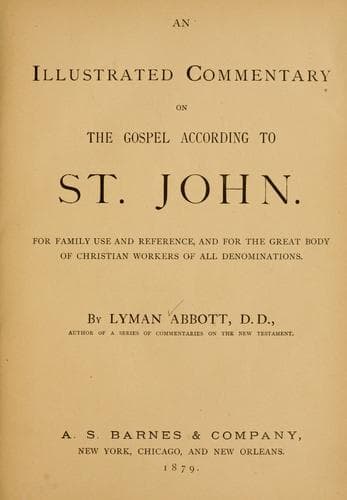
An illustrated commentary on the Gospel according to St. JohnAbbott, Lyman
Religion
An illustrated commentary on the Gospel according to St. John
Abbott, Lyman
Bible. John -- Commentaries
celebrate the feast of Purim, and no reason to believe that our Lord
would have gone there in honor of a festival which was purely
national, not directed by the O. T., observed not in connection with
the temple service, but privately at home, and often, if not
generally, with rioting and excess, rather than with religious
services. I agree therefore with Alford and Tholuck that we cannot
gather with any probability what feast it was.--=And Jesus went up to
Jerusalem.= Presumptively to attend the feast.--=By the sheep-market.=
Rather _sheep-gate_. See Neh. 3:1, 32; 12:39. The site is unknown. The
traditional site, identical with the gate now known as St. Stephen’s,
is pretty effectually disproved by Robinson, who shows that no wall
was existing there at the time of Christ.--=A pool.= Properly _a
swimming-place_. Pools for purposes of bathing were in use in the
great cities of the old world; and recent excavations have brought to
light the fact that ancient Jerusalem was in a remarkable degree
supplied with water. See below.--=Called Bethesda.= The word means
_House of mercy_. The location is entirely uncertain. Tradition places
it near the modern St. Stephen’s gate; but this tradition dates back
only to the 12th century.--=Having five porches.= Opening upon the
bath or tank. In these the sick could lie and be partially protected
from the weather.--=In these lay a great multitude of impotent, blind,
halt, withered.= Four classes intended to embrace all forms of purely
bodily disorder of a chronic character, but not including those
possessed of evil spirits. The _impotent_ are those simply suffering
from special weakness and infirmity or from general debility; the
_halt_ are those deprived from any reason of the full and free use of
their limbs; the _withered_ are those affected by paralysis or kindred
disorders.--=Waiting for the moving of the water * * * * was made
whole of whatever disease he had.= Whether this explanation, _i. e._,
the last clause of ver. 3 and the whole of ver. 4, is genuine or a
later interpolation, is a question of dispute among the critics; the
weight of authority is, on the whole, in favor of its omission; the
weight of reason is wholly so. (_a_) The external evidence is, on the
whole, against its retention. It is wanting in the Vatican, Cambridge,
and Sinaitic manuscripts; in those manuscripts in which it occurs, the
verbal variations are considerable. Tischendorf, Meyer, Alford, and
Tregelles all declare against it. (_b_) The internal evidence is
conclusive. If it had been in the original, the early copyists would
not have omitted it; for in the first centuries there was no such
reluctance to accept the supernatural, and no such discrimination
between wonders that are and wonders that are not miracles, as would
have induced its omission. On the other hand, if no explanation of the
reason why the sick were gathered in the porches of Bethesda were
given in the original account, it would have been very natural for
Public-domain text, read in full here on John Shaqi.
Reviews
Reviews
No reviews yet
Be the first to share your thoughts on this work.
Elsewhere in the archive
Join the Discussion
Join the discussion
Sign in to leave a comment or review.
Sign InorCreate an account