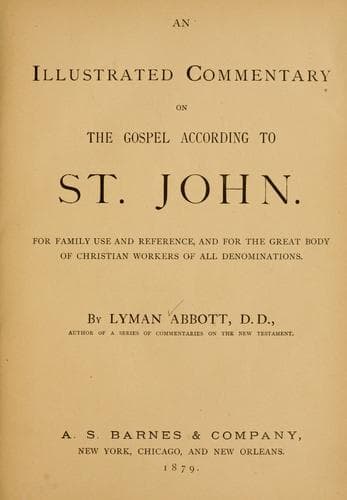
An illustrated commentary on the Gospel according to St. JohnAbbott, Lyman
Religion
An illustrated commentary on the Gospel according to St. John
Abbott, Lyman
Bible. John -- Commentaries
copyists to have supplied the omission by inserting one. (_c_) The
explanation offered by the doubtful passage is itself incredible. It
is a marvel, but it is in no sense a miracle. The irregular and fitful
appearance of help by such an angelic visitor, would have witnessed to
no truth, would have had no tendency to confer faith in God or his
grace. “That God would thus miraculously interpose to throw down from
time to time a boon among a company of cripples, to be seized by
the most forward, selfish, and eager, leaving the most helpless
and miserable to be overwhelmed again and again with bitter
disappointment, is a supposition not admissible.”--(_Jacob Abbott’s
Notes on the N. T._) (_d_) These considerations have led the latest
and best scholars, with substantial unanimity, to omit the explanatory
words of ver. 4, and latter clause of ver. 3. So Alford, Tholuck,
Ebrard, Trench, Olshausen, Meyer, Tischendorf, and Tregelles. But
though it is no part of the sacred record, it probably correctly
states what was the popular belief among the Jews, or at least among
such as resorted to this spring for cure. The real basis of this
belief is indicated by recent researches. These have made it evident
that the pools in and about Jerusalem were connected with each other
by underground aqueducts. Dr. Robinson gives an account of his
exploration of such an aqueduct connecting two pools, the Fountain of
the Virgin and the Pool of Siloam. He satisfied himself that water
flowed from the one to the other reservoir, and he witnessed the
“troubling of the water” in the Fountain of the Virgin. “We perceived
the water rapidly bubbling up from under the lower step. In less than
five minutes it had risen in the basin nearly or quite a foot; and we
could hear it gurgling off through the interior passage. In ten
minutes more it had ceased to flow; and the water in the basin was
again reduced to its former level.” His observation has been since
confirmed by others. It is now difficult to see how the Fountain of
the Virgin could ever have been surrounded by porches or made a
resting-place for the sick; and it is quite certain that the Fountain
of the Virgin cannot be asserted with any positiveness to have been
the Pool of Bethesda. But these discoveries indicate the probably true
explanation of the troubling of the water mentioned, not by John it
will be remembered, but by some subsequent copyist, in the text. The
Pool of Bethesda, probably, was connected by an underground passage
with some intermittent spring, possibly possessing healing virtues,
and the bubbling of the water from time to time gave rise to the
legend of an angelic visitant, which certain of the Jews accepted, but
which the Evangelist does not confirm, and to which there is no
reference in other literature.
5 And a certain man was there, which had an infirmity[162]
thirty and eight years.
Public-domain text, read in full here on John Shaqi.
Reviews
Reviews
No reviews yet
Be the first to share your thoughts on this work.
Elsewhere in the archive
Join the Discussion
Join the discussion
Sign in to leave a comment or review.
Sign InorCreate an account