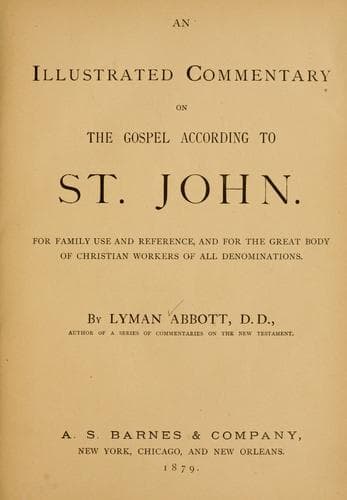
An illustrated commentary on the Gospel according to St. JohnAbbott, Lyman
Religion
An illustrated commentary on the Gospel according to St. John
Abbott, Lyman
Bible. John -- Commentaries
6 When Jesus saw him lie, and[163] knew that he had been
now a long time _in that case_, he saith unto him, Wilt
thou be made whole?
7 The impotent man answered him, Sir, I have[164] no man,
when the water is troubled, to put me into the pool: but
while I am coming, another steppeth down before me.
8 Jesus saith unto him, Rise,[165] take up thy bed, and
walk.
9 And immediately the man was made whole, and took up his
bed, and walked: and on[166] the same day was the sabbath.
[162] Luke 8:43; 13:16.
[163] Ps. 142:3.
[164] Deut. 32:36; Ps. 72:12; 142:4; Rom. 5:6; 2 Cor.
1:9, 10.
[165] Matt. 9:6; Mark 2:11; Luke 5:24.
[166] ch. 9:14.
=5-9. Which had an infirmity.= The original implies rather a loss of
power than a positive disease; probably it was a nervous disease of
the paralytic type.--=Thirty and eight years.= The words “in that
case,” are added by the translator, but they correctly convey the
meaning, which is not that he had been at the Pool of Bethesda, but
that he had been diseased that length of time.--=Wilt thou be made
whole?= Why this question? Not necessarily because there was any
reasonable doubt whether the man desired healing; nor because Christ
required, as a conditional preliminary, the man’s assent to healing on
the Sabbath; nor because he would imply blame, as though the man’s
long infirmity were the result of his own weakness of will; nor,
surely, because he would indicate that he was an impostor and desired
to use his apparent but exaggerated infirmity to appeal to the
compassion of others. All these hypotheses have been suggested. But
Christ almost, if not quite, always requires on the part of the healed
some act of the will precedent to and concurrent with his act of
grace; the cured are never merely receptive and quiescent. I believe
there is a deep religious meaning in this, for every miracle is a
parable of redemption, and that our Lord would teach us that it is
only as we will to be made whole that any wholeness is possible for
us, even through omnipotent divine grace. In this particular case it
is certainly true that the man might have traded on his infirmity and
not really desired to be cured; and though Christ’s knowledge of
character would have rendered the question unnecessary for his own
information, it was not unnecessary to make it clear to others that he
was acting in sympathy with the man, nor was it unimportant as a
disclosure to the man himself that he must rouse himself from the
lethargy of despair, and lay hold, by hope, on the salvation brought
to him.--=I have no man.= It is the friendless who appeals peculiarly
to the Friend of the sinful and the suffering.--=Rise, take up thy bed
and walk.= The original (κράββατόν) implies a small, low bedstead. See
for illustration Mark 2:4, note. Here, however, the term may be used
Public-domain text, read in full here on John Shaqi.
Reviews
Reviews
No reviews yet
Be the first to share your thoughts on this work.
Elsewhere in the archive
Join the Discussion
Join the discussion
Sign in to leave a comment or review.
Sign InorCreate an account