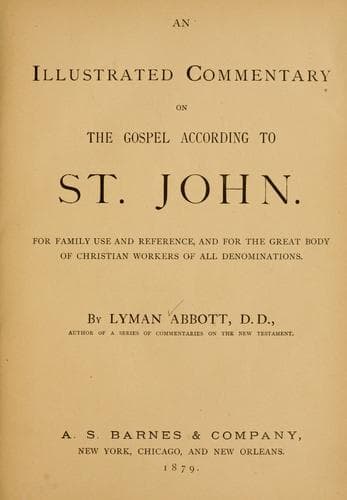
An illustrated commentary on the Gospel according to St. JohnAbbott, Lyman
Religion
An illustrated commentary on the Gospel according to St. John
Abbott, Lyman
Bible. John -- Commentaries
=17-47.= In the study of the discourse which follows, beware of
considering it simply verse by verse. It is not a collection of
incidental aphorisms, but a connected address, the theme being the
character, mission, authority, and credentials of the Son of God. The
Pharisees call Christ to account for healing on the Sabbath; he cites
in his defence the example of his heavenly Father. They seize upon his
language, deduce from it the conclusion that he makes himself equal
with God, and charge him with blasphemy. This serves as the text of
the discourse which follows. He declares that he comes not to draw
allegiance from, but to, the Father; that he acts under the Father’s
will; that to him the Father has committed the whole work of grace on
the earth; that he is even now raising the spiritually dead to life;
that he is to raise the physically dead to a new life; and that he
will finally complete this work entrusted to him, by declaring and
executing the divine judgment. The evidence of his mission and
authority is not in his own words; he is testified to by John the
Baptist; by his own life and work; and by the Scriptures of the O. T.
He closes by pointing out the secret cause of the Jews’ rejection of
him, viz., their personal ambition. Beware, too, of imputing to the
words a dogmatic meaning borrowed from later ecclesiastical
controversies, which they did not bear in the minds of his hearers at
the time. There is little or nothing here respecting the relations of
the Son to the Father, except as the language throughout implies that
the Son is subordinate to and dependent upon the Father; but the
relation of the Son to the human race is clearly revealed, the
relation of life-giver and judge, and is certainly not that of any
man, however endowed, to his fellow-men. Nevertheless this address
contains the christology of Jesus Christ, his own teaching concerning
his own character and work; and it clearly implies, on the one hand,
that he not only represents the Father, as an ambassador might
represent a king, that he is not only clothed with divine authority,
as Moses was clothed, in the administration of the theocracy, with the
authority of God, but that he is a partaker of the divine nature; nor
less clearly, on the other hand, does it imply that his authority is
derived from the Father, that his power is conferred on him by the
Father, that he executes in all things the will of the Father, that he
is to be conceived of not as distinct from, but as one with the
Father, and that his object is in all things to be a way unto the
Father. Against every form of tri-theism, against all substitution of
the Son in the place of the Father, this discourse is a solemn and
earnest admonition, no less than against all belittling of either his
character to that of man or angel, or his mission to that of mere
messenger or teacher.
17 But Jesus answered them, My[171] Father worketh
hitherto, and I work.
[171] chaps. 9:4, 14:10.
Public-domain text, read in full here on John Shaqi.
Reviews
Reviews
No reviews yet
Be the first to share your thoughts on this work.
Elsewhere in the archive
Join the Discussion
Join the discussion
Sign in to leave a comment or review.
Sign InorCreate an account