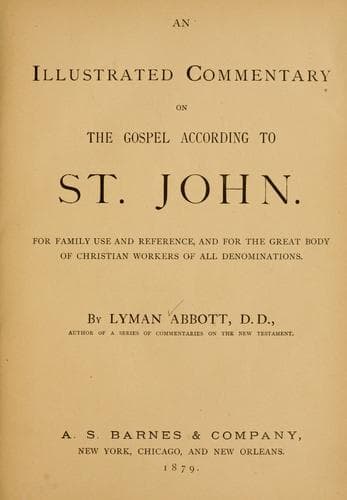
An illustrated commentary on the Gospel according to St. JohnAbbott, Lyman
Religion
An illustrated commentary on the Gospel according to St. John
Abbott, Lyman
Bible. John -- Commentaries
=17. My Father worketh hitherto, and I work.= The argument is very
brief; it is based on the premises that we are to be followers of God
as dear children (Ephes. 5:1), that the Father’s work is a pattern for
our own working. It gives color to the opinion that the days of
creation are long eons or periods; that the seventh day, which God
blessed and on which he rested, is the present period in which the
mere physical work of creation has given place to the higher work of
redemption; thus the Sabbath of God becomes both interpreted and an
interpreter to us of what our Sabbath should be. The divine work does
not cease; the grass grows, the buds swell, the flowers bloom, the
fruits ripen, the rains fall, the winds blow,--but all this is the
work of love; over all this work God’s tender mercies brood (Psalm
145:9). The lesson of nature interpreted here by Christ is that the
work of love is never a violation of the true Sabbath law. This verse,
with Matt. 12:8 and Mark 2:27, give the three canons for the Christian
observance of the Sabbath. (1) The Son of man is Lord also of the
Sabbath. It is then a Christian day, belongs to the Christian
dispensation, is under the Lordship of Christ and in his kingdom, and
is to be kept in that spirit of joyous freedom with which Christ makes
free. (2) The Sabbath is made for man. It is therefore man’s day;
belongs to all men, Gentile and Jew, poor and rich; a day to be used
_for_ man; so that whatever work is necessary to the real abiding
welfare of the human race, is not foreign to this day. (3) My Father
worketh hitherto. The Father’s work is the example and the law for his
children; the work of love, the work for others, the work that has
tender mercy for its inspiration and its overseer, is Sabbath work. It
is to be our rest-day as it is our heavenly Father’s rest-day, and
only so; a prophecy of that eternal rest which will be one of glorious
activity: a rest from care, from worldliness, from the common
temptations of life, but not a day of mere dull cessation of labor.
18 Therefore the Jews sought the more to kill[172] him,
because he not only had broken the sabbath, but said also
that God was his Father, making[173] himself equal with God.
[172] ch. 7:19.
[173] ch. 10:30, 33; Zech. 13:7; Phil. 2:6.
Public-domain text, read in full here on John Shaqi.
Reviews
Reviews
No reviews yet
Be the first to share your thoughts on this work.
Elsewhere in the archive
Join the Discussion
Join the discussion
Sign in to leave a comment or review.
Sign InorCreate an account