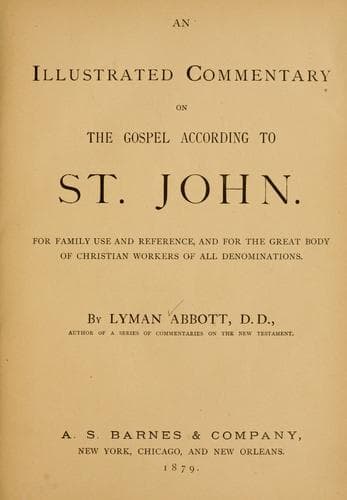
An illustrated commentary on the Gospel according to St. JohnAbbott, Lyman
Religion
An illustrated commentary on the Gospel according to St. John
Abbott, Lyman
Bible. John -- Commentaries
=21-23. For as the Father raiseth up the dead and maketh them to live,
even so the Son, whom he will, makes to live.= Observe, (1) that the
verbs in this sentence are in the present tense; Christ is therefore
speaking of a _present_ resurrection, one now taking place. (2) That
this resurrection is one recognized among men, not one taking place in
the invisible world (ver. 23). (3) That as the result of this
resurrection, the raised pass from death unto life (ver. 24). (4) That
a universal resurrection is not indicated, but only of those whom _he
wills_ to raise (ver. 21). It is then not of a future resurrection of
all men at the last day, nor of a present resurrection of the
literally dead taking place as they die, that Christ here speaks, but
of a spiritual resurrection, taking place on the earth, confined to
those whom the Saviour calls and who hear and answer his call, and so
manifest to men that it is recognized as a sign of the Saviour’s
power. As Christ has power on earth to forgive sins (Mark 2:10), so
also he has power to raise the dead in trespasses and sins. Thus he is
now, as he will be in another sense in the last day, the resurrection
and the life (John 11:25). This theme of a spiritual resurrection and
life-giving occupies verses 21-27; then by a natural transition Christ
passes to the future resurrection of the physical dead. Be not
surprised, he says in substance, at my declarations respecting the
spiritual resurrection; for the final resurrection shall also be at my
voice. Be not surprised at my claim to be now a judge, for the great
day of judgment the Father has also committed into my hands.--=Whom he
will.= This phrase does not indicate “that he specially confers this
grace on none but certain men, that is, on the elect” (_Calvin_); nor
can we say that “He will not quicken others because they believe not”
(_Meyer_), for though this is true, it is neither asserted, nor even
hinted at here; nor is the meaning merely that “in every instance
where his will is to vivify, the result invariably follows”
(_Alford_). Clearly the indication of the passage is that spiritual
life has its source, not in the will of the sinner but in that of the
Saviour (comp. ch. 1:13; Rom. 9:16); but the reason why the divine
will apparently chooses some and not others, whether for reasons in
human character and choice, or for inscrutable reasons, not explained
nor indeed explicable, is not here hinted at.--=For the Father judgeth
no man.= The whole work of judgment, the whole moral government of the
world, the whole course of divine Providence, as regards the nation,
the church, and the individual, is entrusted to the Son. See Psalm 2;
Rev. 1:5.--=That all men should honor the Son even as they honor the
Father.= There is some reasonable ground for a difference of opinion
as to the proper interpretation of the preceding verses, which treat
of the relations of the Father to the Son; and Christian critics are
not wholly agreed respecting their meaning.
Public-domain text, read in full here on John Shaqi.
Reviews
Reviews
No reviews yet
Be the first to share your thoughts on this work.
Elsewhere in the archive
Join the Discussion
Join the discussion
Sign in to leave a comment or review.
Sign InorCreate an account