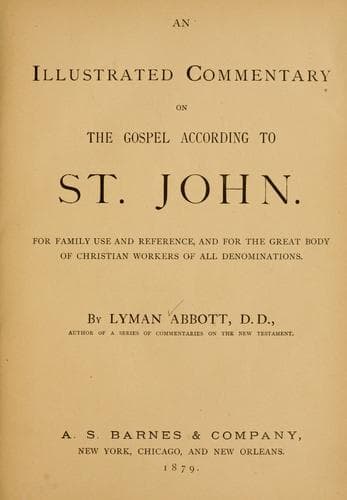
An illustrated commentary on the Gospel according to St. JohnAbbott, Lyman
Religion
An illustrated commentary on the Gospel according to St. John
Abbott, Lyman
Bible. John -- Commentaries
of our infirmities, but was tempted in all points like as we are, yet
without sin.” Our judge is chosen, because he knows our frame, he
understands sympathetically our temptations, is able to make
allowances for all infirmities and weaknesses of humanity, and for all
trials of life, and able, also, to measure at their true worth the
false excuses with which we endeavor to excuse ourselves to ourselves
and to our fellows. Other explanations, for which in detail see Meyer,
as that judgment is a necessary part of redemption, or that it belongs
to Christ as the Messiah, or that it is given to him as a reward for
accepting the humility of human nature, seem to me to be inadmissible.
Judgment is not a part of redemption; it is in no true sense
redemptive; the phrase _a_ son of man never means the Messiah; and it
would be no reward to a tender and loving nature to exercise judgment,
except as it afforded an opportunity for the exercise of mercy in
judgment.
28 Marvel not at this: for the hour is coming, in the
which all that are in the graves shall hear his voice,
29 And shall come forth; they[183] that have done
good, unto the resurrection of life; and they
that have done evil, unto the resurrection of
damnation.[184]
[183] Dan. 12:2.
[184] Matt. 25:46.
=28, 29. Marvel not at this.= Not only because the greater wonder
absorbs the less (_Meyer_), but also because there is nothing strange
in the declaration that he who is to be the final judge of all flesh
should exercise judgment now on men, and he who is to be the final
resurrection and the life should be the resurrection and the life in
the spiritual realm now.--=For the hour is coming.= He does not add
_and now is_, for now he is speaking not of a present resurrection, but
of one to take place only in the future.--=All that are in their
graves shall hear his voice, and shall come forth.= A voice like the
sound of a trumpet (Rev. 1:10), and like the sound of many waters
(Rev. 1:15), that is, like the roar of the ocean for fullness and
power. Comp. 1 Thess. 4:16. The entire language is highly figurative.
If literally interpreted it would seem to imply a bodily resurrection,
and it is apparently so understood by some of the commentators, _e.
g._, Alford and Olshausen; but it is evident that it cannot be
literally interpreted. Thus the dead do not in a literal sense hear
his voice; their arousing is not that of literal sleepers who have
been awakened by a voice. The doctrine that death is a sleep, that the
soul remains in an unconscious state till the resurrection, and that
the life is then anew given to the soul simultaneously with the
re-creation of the body from the dust, is so inconsistent with the
plain teaching of Scripture in many passages (see 1 Cor. 15:36-38, 50,
51), that it cannot be sustained by doubtful interpretations of
pictorial passages like the present one. How little ground there is
Public-domain text, read in full here on John Shaqi.
Reviews
Reviews
No reviews yet
Be the first to share your thoughts on this work.
Elsewhere in the archive
Join the Discussion
Join the discussion
Sign in to leave a comment or review.
Sign InorCreate an account