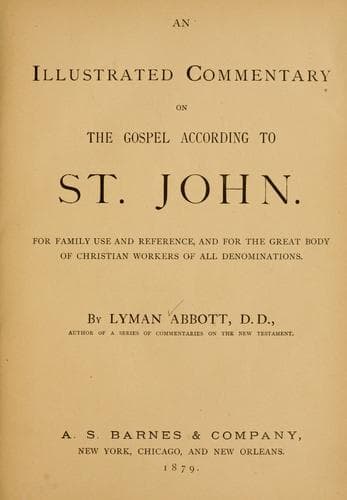
An illustrated commentary on the Gospel according to St. JohnAbbott, Lyman
Religion
An illustrated commentary on the Gospel according to St. John
Abbott, Lyman
Bible. John -- Commentaries
for the opinion that the Bible supports a doctrine of a literal and
universal bodily resurrection, will be evident to the student who
considers the force of the following passages, which are said by
Olshausen, and quoted with apparent approval by Alford, both of whom
seem to believe in a literal resurrection of the body, to be the only
passages in Scripture which imply a resurrection of the bodies of the
impenitent: Acts 24:15; Matt. 10:28; Matt. 25:34, etc.; Rev. 20:5, 12;
Dan. 12:2. No one of these directly asserts the resurrection of the
body, and some of them can hardly be said even remotely to imply it.
The doctrine is directly inconsistent with the teaching of Paul in 1
Cor., ch. 15. See notes there.--=They that have done good unto the
resurrection of life.= That is, unto a resurrection the necessary
result of which is life, life in the Messiah’s kingdom.--(_Meyer._)
--=And they that have practised evil.= The righteous have _done_
good--their fruit remains; the wicked have only _practised_
evil--their works do not follow them. The wheat is garnered into the
storehouses; the chaff is destroyed. See ch. 3:20, 21.--=Unto the
resurrection of judgment.= Observe again that only they that have done
evil come into judgment (verse 24, note). Observe too that it is they
that have done good to whom is given the gift of eternal life, and
they that have practised evil that enter into judgment. The test, and
the only test of character which the New Testament recognizes, is that
of fruit in the actual life (Matt.7:20; 12:33; 25:31-46; Ephes. 5:6; 1
John 3:7, 8). The works of righteousness are the fruits of the Spirit;
his gracious influences are received into the soul by faith, but the
evidence of the abiding of that Spirit consists in the manifestation
of these fruits in a righteous life (John 15:1, 2, 6; Gal. 5:22-24;
James 2:14-26). Living a Christ-like life is the only evidence of
possessing a Christ-like spirit.
30 I[185] can of mine own self do nothing: as I hear, I
judge: and my judgment is just: because I seek not mine own
will, but the will[186] of the Father which hath sent me.
[185] verse 19.
[186] ch. 4:34; 6:38; Ps. 40:7, 8; Matt. 26:39.
=30.= In this verse Christ returns to the statement made in the
beginning of the discourse, ver. 19 (see note there); he does all
things as the representative of the Father and the expression of the
Father’s will.--=As I hear I judge.= As Christ is the image of the
Father, so his voice is the echo of the Father’s voice.--=My judgment
is just, because I seek not my own will, but the will of the Father.=
To the Father there is no law superior to his own will; to the Son the
will of the Father is the law. In this declaration our Lord gives us
an example of the way in which we may secure just judgments in
ourselves. It is self-seeking which obscures the judgment. Unselfish
seeking of the Father’s will is the great clarifier of the moral
judgments of the disciple.
Public-domain text, read in full here on John Shaqi.
Reviews
Reviews
No reviews yet
Be the first to share your thoughts on this work.
Elsewhere in the archive
Join the Discussion
Join the discussion
Sign in to leave a comment or review.
Sign InorCreate an account