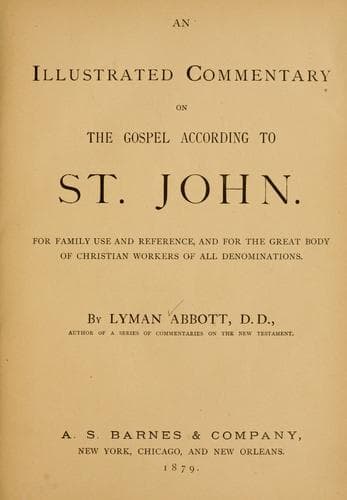
An illustrated commentary on the Gospel according to St. JohnAbbott, Lyman
Religion
An illustrated commentary on the Gospel according to St. John
Abbott, Lyman
Bible. John -- Commentaries
Baptist his own, and declares of himself that he is the Son of God and
the Lamb of God that taketh away the sins of the world. See ch. 1:29,
34.
34 But I receive not testimony from man: but[190] these
things I say, that ye might be saved.
[190] ch. 20:31; Rom. 3:3.
35 He was a burning and a shining light: and ye were
willing[191] for a season to rejoice in his light.
[191] Matt. 21:26; Mark 6:20.
=34, 35. But I receive not testimony from man.= This is not equivalent
to, I will not avail myself of human witness in this matter (_Meyer_);
he does in fact avail himself of human witness, cites it, and declares
the reason why he does so, that his auditors may by it be saved from
fatal error; nor does it merely mean, as Calvin, that he cites this
testimony out of regard to them rather than to himself, though this is
true, and equally true of all his ministry, and of all the testimony
which he cites in support of his divine claims. Here, as in so many
other places in the N. T., especially in the reports of Christ’s
words, the careful study of the original clears up obscurity which is
felt in the translation, and sometimes which any mere translation
fails to clear away. _From_ (παρά), when joined to verbs of inquiring,
asking, and learning, indicates that the matter to be learned is
viewed as in the mental possession of the person cited (see _Winer_, §
47, p. 365), that is, as derived from him and dependent on his
testimony. So in common language with us, “I know such a fact to be
true, for I learned it _from_ Mr. A.,” indicates Mr. A. as the
_authority_ for the statement. Christ’s declaration here then is, not
that he will not use human testimony, but that his claims do not
depend upon it. Compare Matt. 11:27, “No man knoweth the Son but the
Father,” and Matt. 16:17, “Flesh and blood hath not revealed it (the
truth respecting Jesus) unto thee, but my Father which is in heaven.”
The testimony of John the Baptist, like that of all the prophets, is
not in truth testimony of or from man, but testimony _from_ God,
_through_ man, the man speaking as he is moved by the Holy Ghost. And
the moral for us is that all mere human argument for and witness to
the character of Christ breaks down; it is only as the divine
character has been divinely revealed to us, by the Spirit of God, that
we can hope to persuade others of the truth, a lesson abundantly
confirmed in the history of the church by its dealings with
infidelity. Unbelief is to be vanquished by spiritual, not by mere
intellectual power. Alford represents the idea well by a free
translation, “I take not my testimony from man.”--=These things I say
that ye might be saved.= Blind to the testimony of the O. T. (2 Cor.
3:14), unspiritual, and therefore deaf to the inner voice of God (1
Cor. 2:14), there is hope that they may heed the recent testimony of
John, whom all men counted for a prophet (Matt. 21:26), and whose
Public-domain text, read in full here on John Shaqi.
Reviews
Reviews
No reviews yet
Be the first to share your thoughts on this work.
Elsewhere in the archive
Join the Discussion
Join the discussion
Sign in to leave a comment or review.
Sign InorCreate an account