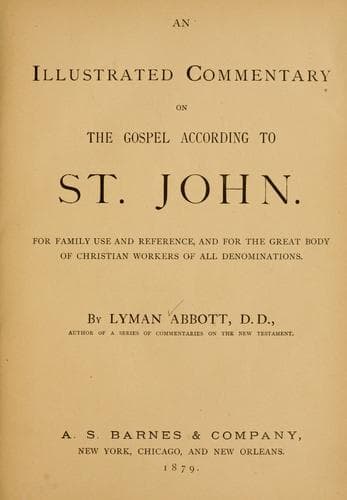
An illustrated commentary on the Gospel according to St. JohnAbbott, Lyman
Religion
An illustrated commentary on the Gospel according to St. John
Abbott, Lyman
Bible. John -- Commentaries
31 If I bear witness[187] of myself, my witness is not true.
[187] ch. 8:14; Prov. 27:2; Rev. 3:14.
=31.= This verse makes a transition from the subject-matter of the
discourse thus far to a new subject. Christ has been speaking of his
own character and authority; he now passes to speak of the evidences
which attest it. The verse is to be read not affirmatively, but
interrogatively. Do you say, if I bear witness of myself, my witness
is not true? I will then point you to other testimony. That this is
the true reading of the verse is evident from ch. 8:14, where Christ
declares that though he bears witness of himself, his witness is true.
He here anticipates the objection there made by the Pharisees (ch.
8:13), and replies to it. In his reply, which extends to verse 39, he
cites in attestation of his mission three witnesses: (1) the testimony
of John the Baptist (vers. 32-35); (2) his own works, including, but
only incidentally, his miracles (ver. 36); (3) the personal testimony
of the Father, speaking chiefly through the O. T. Scripture (vers.
37-39).
32 There is another[188] that beareth witness of me; and I
know that the witness which he witnesseth of me is true.
[188] ch. 8:18; Acts 10:43; 1 John 5:7-9.
33 Ye sent unto John, and[189] he bare witness unto the
truth.
[189] ch. 1:7, 32.
=32, 33. There is another that beareth witness of me.= Most of the
modern commentators consider this _another_ to be the Father. So
Alford, Meyer, Bengel, Tholuck, and others. They understand the
connection to be this: The Father testifies to me; John’s testimony I
do not receive, because it is human and fallible, but in passing I
refer to it, for your salvation. Thus verses 33-35 are parenthetical.
The other interpretation seems to me the more natural and preferable.
Christ gives, in an ascending climax, a threefold testimony to
himself: first the testimony of John, a prophet, rather the prophet
and forerunner of the Messiah; then his own works; finally the
testimony of the Father, in the heart and through the written
word.--=And I know that the witness which he witnesseth of me is
true.= Such language confirming the testimony of John the Baptist is
natural; such language in confirmation of the testimony of the Father
seems to me strained and unnatural. What significance can be given to
the statement, The Everlasting Father testifies of me, and I know that
his testimony of me is true? It is apt if applied to John the Baptist,
a human and fallible witness, whose language might be attributed by
the Jews to extraordinary and mistaken admiration.--=Ye sent unto
John.= The reference is probably to the delegation which came out from
Jerusalem to inquire into John’s character and work (ch. 1:19).--=He
bare witness unto the truth.= That is, To the truth concerning Jesus
Christ. By this declaration Christ makes the christology of John the
Public-domain text, read in full here on John Shaqi.
Reviews
Reviews
No reviews yet
Be the first to share your thoughts on this work.
Elsewhere in the archive
Join the Discussion
Join the discussion
Sign in to leave a comment or review.
Sign InorCreate an account