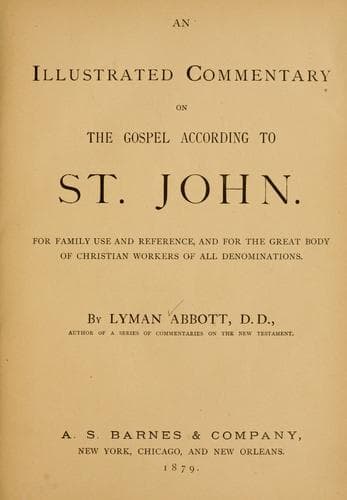
An illustrated commentary on the Gospel according to St. JohnAbbott, Lyman
Religion
An illustrated commentary on the Gospel according to St. John
Abbott, Lyman
Bible. John -- Commentaries
=36. But I have greater witness than that of John; for the works which
the Father hath given me to finish.= From the testimony of John the
Baptist, Jesus passes to the second authentication of his mission, the
works which he is doing. These _works_ are not merely nor primarily
his miracles. Against this narrow and unspiritual interpretation the
church should have been saved by even a careful study of the words.
For (_a_) the word here rendered _works_ (ἔργον) is never used by John
as equivalent to a miracle, but always, when in connection with
Christ, as significant of his whole course of beneficent and redeeming
activity; (_b_) in this very discourse Christ uses it in connection
with and in reference to his work of spiritual life-giving to the dead
in trespasses and sins (vers. 20, 21); (_c_) the phrase “hath given me
to finish” points forward to the time when he should be able to say in
prayer to his Father, “I have finished the work which thou gavest me
to do” (ch. 17:5; comp. 4:34), and in his last triumphant cry upon the
cross, “It is finished” (ch. 19:30). The matter is important because
the church needs to recognize that the evidences of Christianity on
which Christ relied are not the miracles, which are purely historical
acts, the historic veracity of which must be proved like that of any
other past events, but the whole work of redeeming love, the visible
and indubitable fruits of which are to be unceasingly seen in
the victories of Christianity over the individual and over
communities.--=The same works that I am doing.= Not _have done_, which
might have been said of miracles already wrought, but _am now engaged
in doing_, which alone could be said of the unceasing work of him who
ever went about doing good. Observe that the works which he is doing
are those which the Father _hath given him to do_ (vers. 19, 20,
notes), and that whatever the Father hath given him, that he does (ch.
18:11).--=Bear witness of me, that the Father hath sent me.= Because
they are manifestations of the Father’s love. The message which the
Son has come to bring is the message of the Father’s grace (ch. 1:14).
37 And the Father[194] himself, which hath sent me, hath
borne witness of me. Ye[195] have neither heard his voice
at any time, nor seen his shape.
[194] Matt. 3:17; 17:5.
[195] Deut. 4:12; 1 Tim. 6:16.
38 And ye have not his word[196] abiding in you: for whom
he hath sent, him ye believe not.
[196] 1 John 2:14.
Public-domain text, read in full here on John Shaqi.
Reviews
Reviews
No reviews yet
Be the first to share your thoughts on this work.
Elsewhere in the archive
Join the Discussion
Join the discussion
Sign in to leave a comment or review.
Sign InorCreate an account