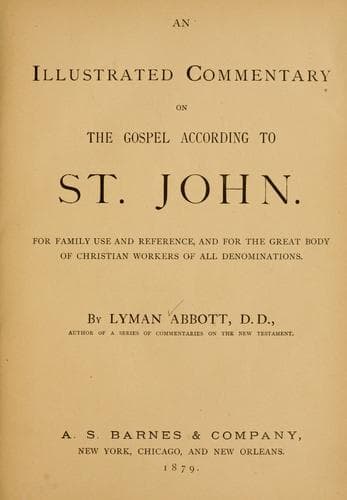
An illustrated commentary on the Gospel according to St. JohnAbbott, Lyman
Religion
An illustrated commentary on the Gospel according to St. John
Abbott, Lyman
Bible. John -- Commentaries
=37, 38. And he which hath sent me, the Father himself, hath borne
witness of me.= The past tense of the verb indicates a completed
testimony, borne in past time, but accessible to present hearers. The
meaning therefore cannot be the witness of the Spirit to Christ’s
character and mission, a continuously fresh testimony, which is
however borne only to those that are already the sons of God, through
a measurable faith in Jesus as Saviour and Messiah. The reference is
possibly in part to the testimony which the Father had borne at the
baptism to Christ as his well-beloved Son (Matt. 3:17), a testimony
repeated on other occasions (Matt. 17:5; John 12:28); but the primary
reference is to the testimony borne to God in the O. T. Scriptures,
which were to the Jewish nation witnesses to the Messiah, whose coming
they heralded, and whose work they described (Luke 24:27-44; Acts
13:27).--=No voice of his have ye ever heard, no appearance of his
have ye ever seen, and his word ye have not abiding in you.= This
gives as nearly literally as is possible the meaning of the original.
Two interpretations are possible. One is that indicated by our English
version. According to this interpretation Christ declares the general
philosophic truth, that the Father is a Spirit, and therefore
invisible and inaudible, to be spiritually discerned; and since the
Jews have not spiritual discernment, since they have not God’s word
abiding in them, they are without any knowledge of God or
understanding of his witness. The other interpretation is that
indicated by the more literal translation given above. According to
this translation it is the language of “reproach for want of
susceptibility to this (divine) testimony” (_Meyer_). This was the
view of Calvin, who here, as in the interpretation of so many other
passages, anticipated the results of later criticism. “When he says
that they had never heard the voice of God or seen his shape, these
are metaphorical expressions, by which he intends to state generally
that they are utterly estranged from the knowledge of God.” This last
I believe to be the correct interpretation, both because it more
nearly accords with the literal rendering of the original, and
because, according to the other interpretation, Christ inserts in the
midst of his discourse an abstract statement of philosophic truth, in
a manner which, if not absolutely artificial, is at least quite unlike
his usual method. _His word abiding in you_ is the word of the O. T.
This they had; but it was external to them. They did not believe it
“with the heart unto righteousness” (Rom. 10:10). It was not an
abiding force in the shaping of their conduct or the formation of
their character. He only can truly comprehend what the Scriptures
teach concerning God, who yields obedience to whatever they teach
concerning duty; for it is only as the divine attributes are
reproduced in us that we can approximate an understanding of them in
Public-domain text, read in full here on John Shaqi.
Reviews
Reviews
No reviews yet
Be the first to share your thoughts on this work.
Elsewhere in the archive
Join the Discussion
Join the discussion
Sign in to leave a comment or review.
Sign InorCreate an account