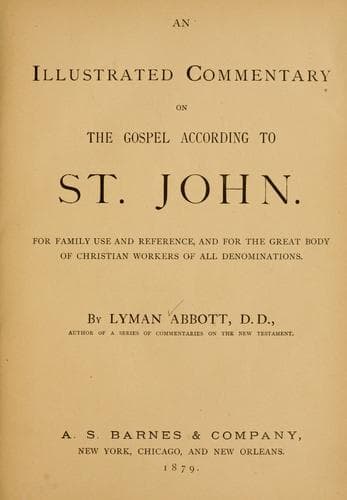
An illustrated commentary on the Gospel according to St. JohnAbbott, Lyman
Religion
An illustrated commentary on the Gospel according to St. John
Abbott, Lyman
Bible. John -- Commentaries
=45-47. Do not think that I will be your accuser before the Father.=
The imagery is borrowed from the course of judicial proceedings. In
the last judgment Christ will be judge (ver. 37), not public
prosecutor.--=There is one that accuseth you.= Observe the present
tense, _who is accusing you_. The law is a perpetual accusation against
the sinner (Rom. 2:15; 3:19, 20), from whose indictments there
is no escape except in the pardon offered by the grace of God through
Jesus Christ. For prophetic and specific accusations of the Jewish
nation in the Mosaic writings, see Deut. 31:21, 26.--=Even Moses.=
The law-giver is put for the law.--=In whom ye have put your hopes.=
(εἰς ὃν) For the meaning of _in whom_ (εἰς ὅν), see 2 Cor. 1:10. _In_
(εἰς) signifies the end toward which any action tends; with verbs
indicating a mental action, the object of that action. The hopes of
the Jews looked toward Moses, _i. e._, toward an exact obedience of
the letter of the law given by Moses, not toward a spiritual communion
with the Father whose children they were called to be. For a portrayal,
autobiographically, of this legal and self-righteous hope, see Phil.
3:4-6.--=Had ye believed Moses.= Not believed _in_ or _on_ him; the
child of God believes the prophets, he believes _in_ or _on_ Christ
only. If the Jews had really believed Moses, even as a teacher, they
would have believed _on_ Christ; for Moses testified of Christ.--=For
he wrote of me.= An incidental testimony to the Mosaic authorship of
the books usually attributed by the Jews to Moses, viz., the first
five books of the O. T.; also an indication of the prophetic and
typical character of the ceremonial law. Moses was a prophet because
the entire O. T. ceremonial and service--temple sacrifices, ablutions,
etc.--were prophecies, fulfilled in and by Christ. Thus Christ himself
incidentally confirms that view of the O. T. ceremonial which
underlies and is most fully expounded by the Epistle to the
Hebrews.--=But if ye believe not his writings, how shall ye believe my
words?= “The meaning is, Men give greater weight to what is written
and published, the letter of a book, than to mere word of mouth; and
ye in particular give greater honor to Moses than to Me: if then ye
believe not what _he_ has written, which comes down to you hallowed by
the reverence of ages, how can you believe the words which are uttered
by _Me_, to whom ye are hostile? This however is not all; Moses leads
to Christ; is one of the witnesses by which the Father hath testified
of Him; ‘if then ye have rejected the _means_, how shall ye reach the
_end_?’ If your unbelief has stopped the path, how shall ye arrive at
Him to whom it leads?”--(_Alford._)
CHAPTER VI.
Ch. 6:1-15. FEEDING OF THE FIVE THOUSAND.--THE GRACE, THE BOUNTY, THE
POWER, AND THE METHOD OF CHRIST ILLUSTRATED.
Public-domain text, read in full here on John Shaqi.
Reviews
Reviews
No reviews yet
Be the first to share your thoughts on this work.
Elsewhere in the archive
Join the Discussion
Join the discussion
Sign in to leave a comment or review.
Sign InorCreate an account