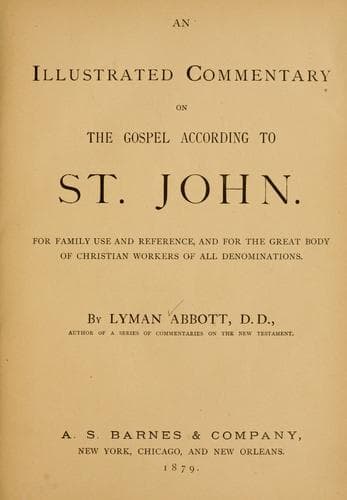
An illustrated commentary on the Gospel according to St. JohnAbbott, Lyman
Religion
An illustrated commentary on the Gospel according to St. John
Abbott, Lyman
Bible. John -- Commentaries
Of this miracle accounts are given by the four Evangelists (Matt.
14:13-33; Mark 6:32-52; Luke 9:10-17); and it is the only miracle
recorded by them all. There are some differences in their records; for
details see notes below. In the main the three Synoptics agree, while
the differences between them and the Fourth Gospel are more
considerable. According to the Synoptics Jesus and his disciples
crossed the Sea of Galilee to the east side; the people, going round
by land, outran them, and apparently were waiting for them on the
shore (Mark); Christ therefore abandoned his original design of rest,
and devoted the day to instruction (Mark) and healing (Matthew and
Luke). When evening was come the disciples asked him to send the
people away to the villages to get necessary food; Jesus replied, Give
ye them to eat; the disciples answered that they had nothing but five
loaves and two small fishes to give; and from these Jesus fed them.
According to John, Jesus crossed over the sea with his disciples, went
up into the hills, and there sat with them; while sitting there he saw
the people coming round by land, proposed to feed them, asked Philip
where they should get the bread, and apparently going down to the
plain to feed the people, took the five loaves and two small fishes
and distributed them among the people. All agree, however, as to the
main facts: the feeding of five thousand on five loaves and two small
fishes, and the gathering of twelve baskets of fragments, are narrated
by all four Evangelists; the subsequent departure of Christ into the
mountain for solitude and prayer, the embarkation of the disciples by
boat, and his walking to them upon the sea are recounted by all but
Luke; Matthew alone gives the account of Peter’s attempt to walk upon
the water to meet Jesus. Harmonists have endeavored to combine these
accounts in one consistent narrative; this is the work, however,
rather of imagination than of criticism; any such harmony is
necessarily hypothetical. The attempts have succeeded in so far as to
show that the accounts are capable of combination. It may be added
that the variations are just such as we might expect in narratives
coming from independent eye-witnesses, and not such as we might expect
in different fictitious accounts, or in different versions of a myth,
derived from the same tradition. The miracle took place immediately on
the return of the twelve after executing the commissions given to them
in Matthew, ch. 10; the immediate object of Christ in retiring to the
eastern shore of the Sea of Galilee was to secure quiet for a personal
conference with the twelve respecting their work (Mark 6:30). For
further statement of the chronology of the event, and the most
probable harmony of the four accounts, see Matt. 14:13-27, note. A
topographical difficulty is presented by an apparent but not real
inconsistency between Luke 9:10 and Mark 6:45. According to Luke,
Christ took the twelve with him into a desert place belonging to
Public-domain text, read in full here on John Shaqi.
Reviews
Reviews
No reviews yet
Be the first to share your thoughts on this work.
Elsewhere in the archive
Join the Discussion
Join the discussion
Sign in to leave a comment or review.
Sign InorCreate an account