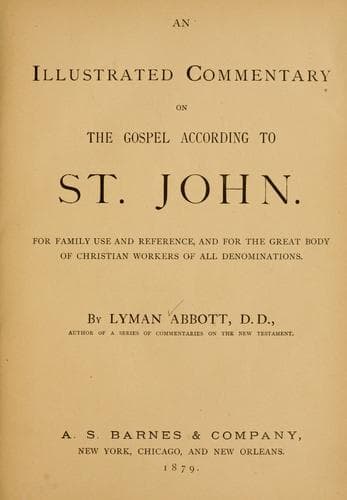
An illustrated commentary on the Gospel according to St. JohnAbbott, Lyman
Religion
An illustrated commentary on the Gospel according to St. John
Abbott, Lyman
Bible. John -- Commentaries
=5, 6. When Jesus then lifted up his eyes.= According to Mark the
people going round by the shore outran Jesus, and he found them there
upon his arrival (Mark 6:33). There is no irreconcilable inconsistency
in the two statements. It may be that Jesus found a few of his
disciples, those that knew his probable destination, and took them up
with him and the twelve into the hills; for the term _disciples_ (ver.
3) is not in the Gospels confined to the twelve apostles; that the
larger multitude followed, looking for the Lord; and that their
gradual congregating moved his compassion (Mark 6:34) and led him to
descend from the retirement of the hills to teach and to heal
them.--=He saith unto Philip.= He spent the greater part of the day in
teaching and healing (Matt. 14:14; Mark 6:34; Luke 9:11). The people,
absorbed by their interest, took no note of the passage of time. As
the afternoon drew on, the disciples proposed to Christ to send the
people away to procure food (Matthew, Mark, Luke); it was probably as
a result of this proposition that Christ addressed to Philip the
question here, Whence shall we buy? This question is reported alone by
John. Why did Jesus address this inquiry to Philip? Some commentators
have supposed that he was the purveyor for Christ and the apostles;
others that his faith was especially weak and needed strengthening;
still others that the question was addressed to him because he
belonged to Bethsaida (ch. 1:44), and therefore would be the one to
know where food could be procured; but there is no evidence to support
either hypothesis. Christ frequently questioned his disciples in order
to bring out to their own consciousness the measure of their faith
(Matt. 9:28; 16:13; 19:17; Luke 24:17, etc.).--=For he himself knew
what he would do.= A statement made by the apostle to emphasize the
truth that Jesus himself was not in perplexity, and taking counsel
with his apostles for his own guidance. This he is never recorded to
have done. According to Matthew the question of providing for the
multitude was not raised until “it was evening” (Matt. 14:15). Yet
both Matthew and John say that “when evening was come” Jesus was left
alone in the mountain (ver. 16; Matt. 14:23). The explanation of this
discrepancy lies in the fact that there were two evenings recognized
by the Hebrews, as by the Greeks, one beginning with the declining sun
at or about three in the afternoon, the other with the setting sun. It
was during the first evening, _i. e._, between three and six, that the
people were fed; at the second evening, _i. e._, about sunset, they
had departed and left Jesus alone.
7 Philip answered him, Two[207] hundred pennyworth of bread
is not sufficient for them, that every one of them may take
a little.
[207] Numb. 11:21, 22; 2 Kings 4:43.
8 One of his disciples, Andrew, Simon Peter’s brother,
saith unto him,
Public-domain text, read in full here on John Shaqi.
Reviews
Reviews
No reviews yet
Be the first to share your thoughts on this work.
Elsewhere in the archive
Join the Discussion
Join the discussion
Sign in to leave a comment or review.
Sign InorCreate an account