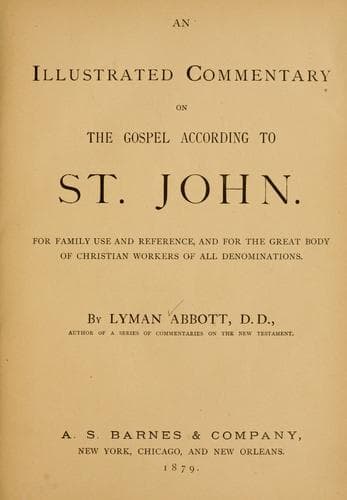
An illustrated commentary on the Gospel according to St. JohnAbbott, Lyman
Religion
An illustrated commentary on the Gospel according to St. John
Abbott, Lyman
Bible. John -- Commentaries
9 There is a lad here, which hath five barley loaves, and
two small fishes: but what are they among so many?
=7-9. Two hundred pennyworth of bread.= The penny, or denarius, was
equal in value to seventeen cents American coin; but it was the day’s
wages of a common laborer (Matt. 20:2); two hundred pennyworth
therefore would be practically equivalent to $200 worth in our time.--
=One of his disciples said unto him.= Christ bade them ascertain how
much they had on hand for themselves (Mark 6:38). Andrew ascertained
and reported in response to Christ’s direction. The lad here mentioned
was therefore probably some one in attendance upon Christ and the
twelve, and carrying their simple store for them. How much blessing
the Lord can impart to the service of a little child. Comp. 2 Kings
5:2, 3. Here a _little boy_ (παιδάριον) had but five loaves, and they
of barley, and yet when given to the Lord, and blessed by Him, they
feed five thousand.--=Five barley loaves.= The loaves of the Jews were
thin round cakes or crackers; for illustration and description, see
Mark 8:3-5, note. Barley was the food only of the lower classes. “One
in the Talmud, speaking of barley bread, says, ‘There is a fine crop
of barley.’ Another answers, ‘Tell this to the horses and asses.’ A
Roman soldier who had quitted his ranks, had for part of his
punishment that he received barley bread instead of wheaten.”--(_Geike’s
Life of Christ._) Thus we have here (1) an indication of the
simplicity of the living of our Lord; without a place to lay his head,
_i. e._, a permanent home, and with the plainest possible food for his
fare, the bread of the peasant classes; (2) a suggestion of true
benevolence; he did not create wheaten bread for the multitude; he
gave such as he had. To share what we have, not to aspire to give what
we have not, is true benevolence.--=And two small fishes.= The word
here rendered _small fishes_ (ὀψύριον) denotes any relish eaten with
bread; hence, because fish was a common accompaniment, the most common
from the animal kingdom, it came to be used for fish, generally salt
fish, prepared for and used as a relish.
10 And Jesus said, Make the men sit down. Now there was
much grass in the place. So the men sat down, in number
about five thousand.
11 And Jesus took the loaves: and when he had given thanks,
he distributed to the disciples, and the disciples to them
that were set down; and likewise of the fishes as much as
they would.
Public-domain text, read in full here on John Shaqi.
Reviews
Reviews
No reviews yet
Be the first to share your thoughts on this work.
Elsewhere in the archive
Join the Discussion
Join the discussion
Sign in to leave a comment or review.
Sign InorCreate an account