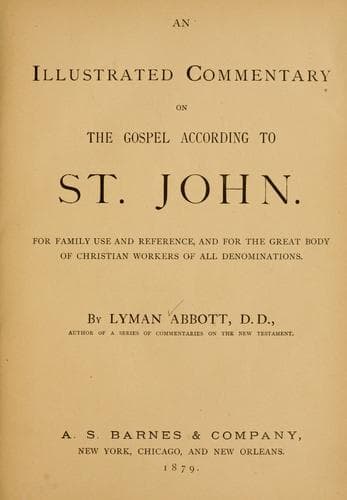
An illustrated commentary on the Gospel according to St. JohnAbbott, Lyman
Religion
An illustrated commentary on the Gospel according to St. John
Abbott, Lyman
Bible. John -- Commentaries
19 So when they had rowed about five and twenty or thirty
furlongs, they see Jesus walking on the sea, and drawing
nigh unto the ship: and they were afraid.
20 But he saith unto them, It is I;[213] be not afraid.
[213] Ps. 35:3; Isa. 43:1, 2; Rev. 1:17, 18.
21 Then they willingly received him into the ship; and
immediately the ship was at the land whither they went.
=19-21. So when they had rowed about five-and-twenty or thirty
furlongs.= _Stadia_; that is, a little over three miles. The lake at
this point is about six miles across; they had therefore rowed about
half way across the lake; but they were unable to make head against
the wind, and could not reach the northern shore to keep their
appointment with Jesus. _It was while they were endeavoring to come to
Jesus that he came out upon the sea to meet them._--=They see Jesus
walking on the sea.= That he was really walking on the sea, not
standing on the land and supposed to be on the sea because only dimly
discerned through the storm and darkness (_Bleek_), is evident from
the facts, (1) that Peter went out to meet him (Matt. 14:28-31); (2)
that on receiving him into the ship they were immediately at the land
“unto which they were going” (εἰς ἣν ὑπῆγον). This was the plain of
Gennesaret, on which Capernaum was situated, and was two or three
miles away from the point where they met Jesus; for they had as yet
rowed only about half the distance across the lake.--=He saith unto
them, It is I.= Literally, _I am_. The same language used by Jesus in
Jerusalem (ch. 8:58), for which the Pharisees would have stoned him,
and in the O. T. to designate Jehovah (Exod. 3:14). Here I should
prefer to give it this meaning. Christ says not merely, “It is I, your
Friend and Master;” he says, at least implies, It is the “I am” who is
coming to you, the Almighty One who rules winds and waves, who made
them, and whom they obey.--=Be not afraid.= This is the message of
Christ to his people in the hour of his advent (Luke 2:10); of their
tempest experiences of temptation and struggle (Matt. 14:27; Mark
6:50; 1 Pet. 3:14); their sorrows (Matt. 28:10; Mark 5:36); and their
hour of dangerous duty (Acts 18:9).--=Then they willingly received
him.= Literally, _Thereupon they willed to receive him_. If this
account stood alone we might perhaps doubt whether he actually did
enter the ship, as some rationalistic commentators have done; but
Matthew and Mark are explicit in their statements that he did
so.--=And immediately the ship was at the land to which they were
going.= That is, the shore at Capernaum. This, coupled with the
statement of ver. 19 that they had only rowed twenty-five or thirty
furlongs, _i. e._, about half way, seems clearly to imply a further
miracle, unless indeed we give to the word _immediately_ (εὐθέως) a
large latitude of expression, understanding it merely to mean that
since the wind at once ceased (Matt. 14:32) they had no further
Public-domain text, read in full here on John Shaqi.
Reviews
Reviews
No reviews yet
Be the first to share your thoughts on this work.
Elsewhere in the archive
Join the Discussion
Join the discussion
Sign in to leave a comment or review.
Sign InorCreate an account