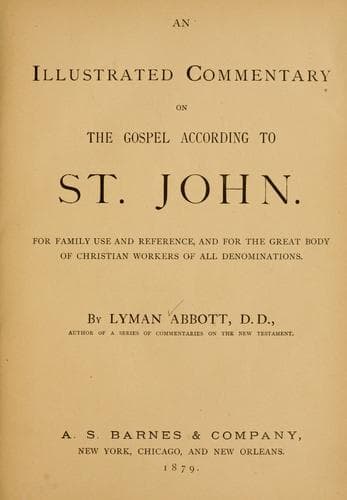
An illustrated commentary on the Gospel according to St. JohnAbbott, Lyman
Religion
An illustrated commentary on the Gospel according to St. John
Abbott, Lyman
Bible. John -- Commentaries
difficulty in reaching their destination. Matthew adds that they that
were in the ship came and worshipped Jesus, saying, “Of a truth thou
art the Son of God;” and Mark that they were amazed beyond measure,
“for they considered not the miracle of the loaves, for their heart
was hardened,” rather _dull, stupid_. They had been amazed at the
miracle of the loaves, but they had not deduced from it the natural
conclusion that Christ was the Lord of nature, so when a new
manifestation of his power was made they were as much surprised as if
they had never seen any previous manifestation. In this they were very
typical of Christians in all ages of the church.
* * * * *
Ch. 6:22-71. SERMON ON THE BREAD OF LIFE.--THE CONDITION OF ETERNAL
LIFE: FEEDING ON CHRIST.--THE TRUE NATURE OF FAITH SYMBOLIZED.--THE
MEANING OF THE LORD’S SUPPER.
PRELIMINARY NOTE.--Before entering upon this discourse in detail, some
preliminary considerations are necessary. 1. _The report._ There is no
reason to believe that we have a verbatim report of Christ’s
discourse, but good reason to believe the reverse. John makes no claim
to give the sermon in full. The language of ver. 59 implies that he
does not. The whole sermon occupies in deliberate reading less than
five minutes. We can hardly suppose that an actual discourse delivered
in the synagogue would have been compressed in so brief a space. We
have then, here, John’s subsequent report written out from memory,
though from memory quickened by divine inspiration, of a discourse
very much longer than the report. It embodies in John’s language the
substance of Christ’s thoughts. 2. _The circumstances and connection._
After the feeding of the 5,000, the apostles embark in their boat;
Christ goes up into the hills to pray; the people linger a while for
his return, then conclude that he has returned to Capernaum, and go
back to Capernaum themselves; on the following Sabbath morning he
enters the synagogue; their astonishment at his approach is great;
they break out in questioning, How did you get here? His answer
diverts them from mere astonishment to a serious consideration of
spiritual truth: “Ye are seeking me, not because of the evidence I
have given of my divine commission, but because ye did eat of the
loaves and were filled. Labor not for the meat that perisheth, but for
that meat which endureth unto everlasting life.” Their response
indicates some seriousness of desire: “What is the work which God
would have us to do that we might have this bread of life as our
reward?” This is the question of all religious aspiration, and
Christ’s answer is the response of Christianity to the soul-hunger of
the ages: “This is the work of God, that ye have faith in him whom he
hath sent.” This I believe to be the text of the sermon which follows;
it gives the subject; it is the key to its mysticism. The object of
the discourse is to give Christ’s definition and interpretation of
faith.
Public-domain text, read in full here on John Shaqi.
Reviews
Reviews
No reviews yet
Be the first to share your thoughts on this work.
Elsewhere in the archive
Join the Discussion
Join the discussion
Sign in to leave a comment or review.
Sign InorCreate an account