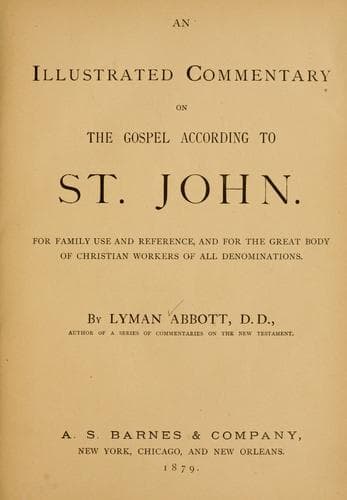
An illustrated commentary on the Gospel according to St. JohnAbbott, Lyman
Religion
An illustrated commentary on the Gospel according to St. John
Abbott, Lyman
Bible. John -- Commentaries
perfected redemption (1 John 3:2; Ps. 17:15). We are not _satisfied_
till we awake in his likeness.--=Ye also have seen me and ye have not
had faith.= See ch. 20:29. The reference here may either be to words
actually uttered in this discourse, but not reported by John, or to
what he has said by implication though not by exact words, or to
rebukes uttered on some previous occasion, _e. g._, John 5:38, 40, 43.
37 All[226] that the Father giveth me shall come to me; and
him[227] that cometh to me I will in no wise cast out.
[226] verse 45, ch. 17:6, 8, etc.
[227] Ps. 102:17; Isa. 1:18; 55:7; Matt. 11:28; Luke
23:42, 43; 1 Tim. 1:15, 16; Rev. 22:17.
38 For I came down from heaven, not to do mine own will,
but[228] the will of him that sent me.
[228] ch. 5:30; Ps. 40:7, 8.
=37, 38. The all which the Father has given to me shall come toward
me, and he that comes toward me I will in no wise cast out.= _Toward_,
not _to_ me. The original (πρὸς) indicates the object toward which
anything is directed, not ordinarily the goal actually reached. The
promise then is that he who sets out in the direction of Christ shall
not be rejected by him. He does not wait till we have come to him; he
receives us when we start toward him. In this and the next verse _all_
(πᾶν) is in the neuter gender, indicating, not that the body is
included with the soul (_Maurice_), but that _the whole_ is given by
the Father in its totality, but is received by the Son separately and
individually. “In Jesus Christ’s discourses, that which the Father
hath given to the Son himself is termed, in the singular number and
neuter gender, _all_; those who come to the Son himself are described
in the masculine gender, or even the plural number, _every one_, or
_they_. The Father has given to the Son the whole mass, as it were,
that all whom he hath given may be one; that whole the Son develops
individually in the execution of the divine plan.”--(_Bengel._)
Christ’s language here indicates his dependence upon the Father’s will
and power, and is analogous to that in many of his discourses,
especially in those reported by John. He has come to do his Father’s
will; the works which he does are those which his Father has given him
to do, and are done by his Father’s power; the words which he speaks
are his Father’s words; his whole life is represented as the incarnate
expression of his Father’s will; and those whom he saves are saved not
by his own independent power, they are those whom his Father has given
him (ch. 10:28, 29). Here then I understand Christ neither to limit
his salvation nor to declare it to be without limit. He simply asserts
on the one hand that his saving power is efficacious only over those
whom the Father has given unto him, and on the other that there is
nothing lacking in his grace or power which shall cause those thus
given to fail of a perfected salvation. As a Saviour he is the
Public-domain text, read in full here on John Shaqi.
Reviews
Reviews
No reviews yet
Be the first to share your thoughts on this work.
Elsewhere in the archive
Join the Discussion
Join the discussion
Sign in to leave a comment or review.
Sign InorCreate an account