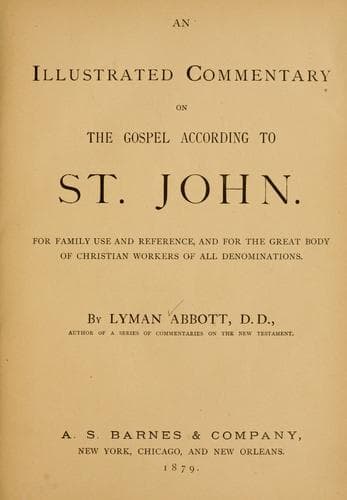
An illustrated commentary on the Gospel according to St. JohnAbbott, Lyman
Religion
An illustrated commentary on the Gospel according to St. John
Abbott, Lyman
Bible. John -- Commentaries
=34. Lord, evermore give to us this bread.= Comp. ch. 4:15, note.
Not spoken ironically (_Calvin_), nor with a definite idea of some
miraculous kind of sustenance, a magic food or means of life from
heaven (_Alford_, _Meyer_), nor with a serious comprehension of
his spiritual meaning and a sincere desire for his spiritual gift
(_Maurice_, _Lucke_). The people were shallow and superficial;
without comprehending the meaning of Christ’s words, they yet saw
in them the offer of something desirable, they knew not what, and
asked for it. In the minds of some there may have been a dim sense
of the value of the inner life, such as is sometimes borne in upon
sensual and superficial natures by the mere power of the presence of a
great soul. Comp. Luke 14:15. There, as here, Christ by his teaching
rebukes the superficial and ignorant desire for an uncomprehended
blessedness; there, by showing parabolically how the spiritual food
is declined by those to whom it is offered; here, by interpreting
the nature of spiritual food. The rejection of Christ by the people
here, illustrates the parable uttered by Christ there.
35 And Jesus said unto them, I am the bread of life:
he[223] that cometh to me shall never hunger; and he[224]
that believeth on me shall never thirst.
[223] Rev. 7:16.
[224] chaps. 4:14; 7:38.
36 But I said unto you, That ye[225] also have seen me, and
believe not.
[225] verse 64.
=35, 36. I am the bread of life.= They say, Give us this bread. His
reply is, The bread is already given; it is for you to accept and feed
upon it. And this is always the answer of the gospel to every soul
that cries out for a Saviour and a salvation. How the soul is to
accept this bread he then goes on to say.--=He that cometh to me shall
not hunger, and he that hath faith in me shall never thirst.= It is
clear that the “coming” and “believing in” here are equivalent to the
eating and drinking of ver. 54. See notes there. The coming is a
continuous coming (present participle with πρός); a coming into
Christ’s likeness, and therefore into spiritual unity with him; a
coming perfected only by the process of feeding upon him, drinking in
his spiritual power so as to be transformed by it. It is the coming
which David describes in Psalm 63:8, “My soul followeth hard after
thee,” and Paul in Phil. 3:13, 14, “Forgetting those things which are
behind, and reaching forth unto those things which are before, I press
toward the mark for the prize of the high calling of God in Christ
Jesus.” Comp. with the promise here Matt. 5:6; Rev. 7:16. All
spiritual hunger and thirst are not ended when Christian experience
begins, because in this life we are ever coming toward Christ, we have
never come fully into him. This coming is consummated when we are one
with Christ as he is one with the Father (John 17:21, 22); the promise
of the gospel is then fulfilled in the glorious satisfaction of a
Public-domain text, read in full here on John Shaqi.
Reviews
Reviews
No reviews yet
Be the first to share your thoughts on this work.
Elsewhere in the archive
Join the Discussion
Join the discussion
Sign in to leave a comment or review.
Sign InorCreate an account