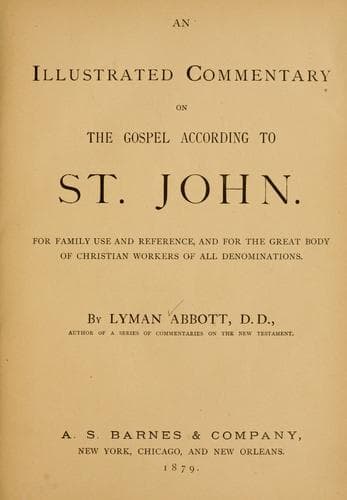
An illustrated commentary on the Gospel according to St. JohnAbbott, Lyman
Religion
An illustrated commentary on the Gospel according to St. John
Abbott, Lyman
Bible. John -- Commentaries
After this chapter had gone to press a remarkable article from the pen
of Dean Stanley appeared on “The Eucharist” in the Nineteenth Century
(May, 1878), in which he arrives at substantially the same conclusions
that I have arrived at in these notes, and enforces them with his
usual eloquence and learning. He urges that in all religious
ordinances we ought to try to get beneath the phrases we use, and not
to rest satisfied with the words, however excellent, till we have
ascertained their meaning; that Christ’s words here and in the
appointment of the last supper as a permanent memorial ordinance are
evidently metaphorical; that the very strangeness of the metaphor
should turn our thoughts from the outward form to the inward essence;
that the body and flesh signify the personality and character of
Christ; that we must incorporate in ourselves, that is in our
moral natures, the substance--the moral substance--of the teaching
and character of Jesus Christ; that this is the only true
transubstantiation; that the blood of Christ is his spirit, the inmost
essence of his character, the self of his self; and that to drink his
blood is to imbibe this inmost spirit; that this spirit is love or
charity, which is throughout the New Testament represented as the
fundamental essence of the highest life of God, and therefore of his
children; and he interprets verses 53-56 here, in accordance with
these principles, as follows: “This is one of those startling
expressions used by Christ to show us that he intends to drive us from
the letter to the spirit, by which he shatters the crust and shell in
order to force us to the kernel. It is as if he said: ‘It is not
enough for you to see the outward face of the Son of man, or hear his
outward words, or touch his outward vesture. That is not himself. It
is not enough that you walk by his side, or hear others talk of him or
use terms of affection and endearment toward him. You must go deeper
than this; you must go to his very inmost heart, to the very core and
marrow of his being. You must not only read and understand, but you
must mark, learn, and inwardly digest, and make part of yourselves,
that which alone can be part of the human spirit and conscience.’ It
expresses, with regard to the life and death of Jesus Christ, the same
general truth as is expressed when St. Paul says, ‘Put ye on the Lord
Jesus Christ’--that is, clothe yourselves with his spirit as with a
garment; or again, ‘Let the same mind be in you that was in Christ
Jesus.’ It is the same general truth as when our Lord himself says, ‘I
am the vine; ye are the branches.’”
59 These things said he in the synagogue, as he taught in
Capernaum.
60 Many therefore of his disciples, when they had heard
_this_, said, This is an hard saying; who can hear it?
Public-domain text, read in full here on John Shaqi.
Reviews
Reviews
No reviews yet
Be the first to share your thoughts on this work.
Elsewhere in the archive
Join the Discussion
Join the discussion
Sign in to leave a comment or review.
Sign InorCreate an account