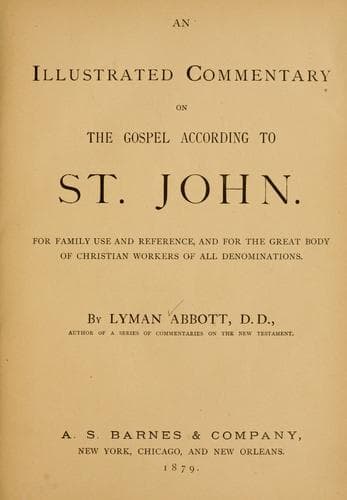
An illustrated commentary on the Gospel according to St. JohnAbbott, Lyman
Religion
An illustrated commentary on the Gospel according to St. John
Abbott, Lyman
Bible. John -- Commentaries
=10-13. Not openly, but as it were in secret.= Not _secretly_, but _as
if_ in secret, that is, quietly, unostentatiously, _incognito_, in
contrast to the way in which his brothers wished him to go up. “Not in
the company of a caravan of pilgrims or in any other way of outward
observation, but so that the journey to that feast is represented as
made in secrecy, and consequently quite differently from his last entry
at the feast of the Passover.”--(_Meyer._) The description of this
journey to Jerusalem renders it improbable that it is to be identified
with the journey described in Luke 9:51, 52. See Prel. Note.--=Then
the Jews sought him.= By the _Jews_ John generally if not invariably
means the inhabitants of Judea, in contradistinction to the other
inhabitants of the Holy Land. See ch. 6:41, note.--=Where is that
fellow= (ἐκεῖνος)? The language is derisive. “Thus contemptuously can
they speak of the man, that they cannot name him.”--(_Luther._)--=And
there was much murmuring.= The original (γογγυσμός) implies suppressed
discourse.--=Some indeed said.= The Greek particle which I have
rendered _indeed_ (μέν) implies a concession, at the same time
pointing forward to something antithetic. The implication is that
among the Judeans the believers were a minority.--=No! but he
deceiveth the people.= He that is popular with the multitude is
generally looked upon with aversion by the hierarchy.--=No one spoke
openly.= “Both mistrusted the hierarchy; even those hostile in their
judgment were afraid, so long as they had not given their official
decision, that their verdict might be reversed. A true indication of
an utterly Jesuitical domination of the people.”--(_Meyer._) Hostility
to Christianity fears nothing so much as free discussion; and it quite
accords with human nature that the consideration of Christ’s claims by
the people at all should be dreaded by the priesthood. The
interpretation of Alford, Godet, Tholuck, and others, that only the
friends of Christ feared to speak openly, is in direct conflict with
the explicit language of the narrative. Maurice pictures the scene
well: “It is a hum of voices. There is a fear of something, the people
do not well know of what. It is a fear of the Jews; the apostle says
each fears the other. There is a concentrated Jewish feeling in the
Sanhedrim, among the rulers, which all tremble at. Till that has been
pronounced--above all, while there is a suspicion that it will come
forth in condemnation--it is not wise for any to commit themselves.
Brethren, do we not know that this is a true story? Must it not have
happened in Jerusalem then, for would it not happen in London now?”
14 Now about the midst of the feast, Jesus went up into the
temple, and taught.
15 And[266] the Jews marvelled, saying, How knoweth this
man letters, having never learned?
[266] Matt. 13:54.
Public-domain text, read in full here on John Shaqi.
Reviews
Reviews
No reviews yet
Be the first to share your thoughts on this work.
Elsewhere in the archive
Join the Discussion
Join the discussion
Sign in to leave a comment or review.
Sign InorCreate an account