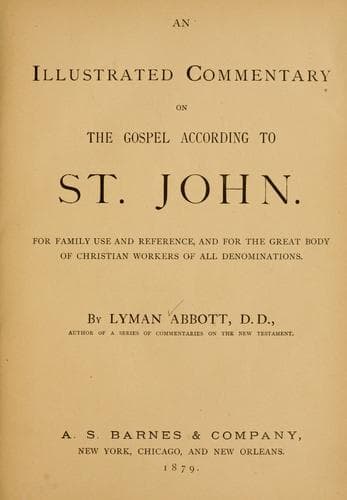
An illustrated commentary on the Gospel according to St. JohnAbbott, Lyman
Religion
An illustrated commentary on the Gospel according to St. John
Abbott, Lyman
Bible. John -- Commentaries
=16, 17. My teaching is not mine, but his that sent me.= For
_doctrine_ read _teaching_; for not merely the subject-matter taught,
but the power with which it was presented, was divine. _My teaching is
not mine_ is not a hyperbole. It is not merely equivalent to “not
acquired by any labor on my part in learning” (_Bengel_), or “not an
invention of my own” (_Geikie_). Neither in origin nor in aim was
Christ’s teaching his own. Ever about his Father’s business, he was
ever teaching his Father’s words and doing his Father’s works (ch.
5:19, 30). In a sense every true Christian teacher should be able to
repeat this saying of Christ (chaps. 14:26; 16:13). It does not follow
that the Christian teacher need not be a Christian student; but it
does follow that he should be a student only of those things which
enable him better to understand and interpret the Father’s will and
nature. Only so far as schools of theological thought help him to do
this are they truly Christian schools.--=If any one wills to do his
will, he shall know concerning the teaching, whether it be of God or
whether I speak of myself.= An often misunderstood declaration. The
promise is not that if any man does God’s will all theology shall be
made clear to him, nor even that he shall be brought to a correct
apprehension of the most important truths of the Christian system. The
last clause qualifies the first; the declaration is that if any man
purposes to do God’s will, _makes that his ultimate and supreme
choice_ (1 Tim. 6:11-16), he shall know respecting Christianity
_whether it is of divine or human origin_. The declaration is both a
promise and the enunciation of a spiritual law. The purpose to do
God’s will itself clarifies the spiritual sight, so that the soul
recognizes the Spirit of God in the life, the character, and the
teachings of his Son. The degree of advancement which one subsequently
makes in comprehending the full significance of those teachings will
depend partly upon the purity of his spiritual purposes, but partly
upon other conditions. Not the mere outward obedience to God’s
commandments, but a true spiritual purpose, is declared to be the
condition of spiritual light; and to that purpose is attached, not a
promise of _all_ light, but only of so much as will enable the soul to
know the source from which it may obtain constantly increasing
illumination. Nevertheless, the first step toward the solution of any
theological difficulty whatever, is repentance of sin and practical
obedience to the voice of God in the soul. Except a man be born again
he cannot _see_ the kingdom of God.
18 He[269] that speaketh of himself seeketh his own glory:
but he that[270] seeketh his glory that sent him, the same
is true, and no unrighteousness is in him.
[269] ch. 8:50.
[270] Prov. 25:27.
19 Did not Moses[271] give you the law, and _yet_ none[272]
of you keepeth the law? Why go ye about to kill[273] me?
Public-domain text, read in full here on John Shaqi.
Reviews
Reviews
No reviews yet
Be the first to share your thoughts on this work.
Elsewhere in the archive
Join the Discussion
Join the discussion
Sign in to leave a comment or review.
Sign InorCreate an account