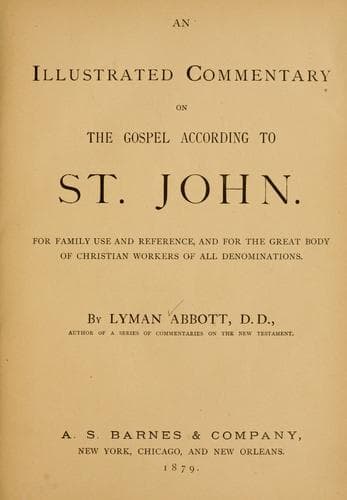
An illustrated commentary on the Gospel according to St. JohnAbbott, Lyman
Religion
An illustrated commentary on the Gospel according to St. John
Abbott, Lyman
Bible. John -- Commentaries
=20-24. Thou hast a devil; who goeth about to kill thee?= It is evident
from ver. 25 that some of his auditors knew the secret design which had
been formed for Christ’s assassination. Their language here is that
of foulest abuse. I judge then that they were startled by Christ’s
sudden revealing of the secret designs against him; and with that
inconsistency which is common to the self-condemned, they in the same
sentence denied that his death had been compassed, and implied that the
fact that it was compassed had been disclosed to him by an evil spirit
which possessed him.--=Jesus answered * * * * I have done one work,
and ye all marvel.= The work referred to is that described in the
fifth chapter of John, the only miracle in Jerusalem up to this time
which is described in detail; not the only one which he had wrought
(chaps. 2:23; 3:2), but presumptively the last one. They wondered not
at the miracle, but at the fact that he had performed it on
the Sabbath day (ch. 5:16). It is not necessary to give to the
word _wonder_ here any accessory idea, as of doubt (_Bengel_)
or disquietude (_Chrysostom_); Christ begins with the mildest
characterization of their sentiment as that of mere surprise. Here, as
habitually, he does not proceed to severe language till milder
language has proved unavailing.--=Moses therefore gave unto you
circumcision.= There is some doubt whether the word _therefore_
belongs to this or to the preceding verse; _i. e._, whether Christ
says, _I have done one work, and ye all therefore marvel_, or, _Moses
therefore gave unto you circumcision, not because it is of Moses, but
of the fathers_. The latter reading is preferred by the later
scholars, _e. g._, Bengel, Meyer, Alford, against Olshausen, Tholuck.
Either is grammatically possible; and the purely grammatical
considerations appear to me to be about equally balanced. The latter
interpretation is preferable, because it gives a better meaning to the
sentence. Accepting this rendering, the meaning appears to be, Moses
gave unto you circumcision for this reason, viz., because it was
patriarchal, not because it originated with him. And this statement of
the reason of the Mosaic law respecting circumcision affords a basis
for the argument which follows. It was a saying of the rabbis “that
circumcision drives away the Sabbath,” and they held that the rite,
notwithstanding the work which it necessarily entailed, might be
performed on the Sabbath day, because it was of patriarchal origin,
and so antedated the Mosaic institution of the Sabbath. Christ,
referring to this fact, convicts the Jews of inconsistency in being
angry with him for placing the law of mercy above the law of the
Sabbath. For the law of mercy was older than either; it belongs to the
eternal law of God’s nature.--=That the law of Moses should not be
broken.= That law prescribed that circumcision should be performed on
the eighth day (Lev. 12:3); to allow that day to pass by, therefore,
Public-domain text, read in full here on John Shaqi.
Reviews
Reviews
No reviews yet
Be the first to share your thoughts on this work.
Elsewhere in the archive
Join the Discussion
Join the discussion
Sign in to leave a comment or review.
Sign InorCreate an account