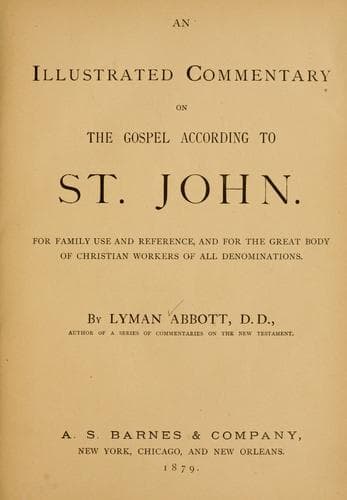
An illustrated commentary on the Gospel according to St. JohnAbbott, Lyman
Religion
An illustrated commentary on the Gospel according to St. John
Abbott, Lyman
Bible. John -- Commentaries
without circumcision would be a breach of the law.--=Because I have
made an entire man= (ὅλον ἄνθρωπον) =well on the Sabbath day=. We can
hardly suppose, with Bengel and Olshausen, that the _entire man_ here
signifies the healing of both soul and body; for there is no evidence
in the original account that the physical was accompanied with a
spiritual healing, and no likelihood that Christ’s auditors would have
understood him here to refer to spiritual healing. The contrast rather
seems to be between circumcision as an act of wounding, which brought
only ceremonial cleanness, and the miracle at the pool of Bethesda,
which gave relief from the consequences of sin (ch. 5:14), and gave
health to the whole body.--=Judge not according to appearance, but
judge righteous judgment.= See Zech. 7:9. One of Christ’s Sabbath
laws; we are ourselves to avoid, but we are not to condemn in others,
the appearance of evil. What is Sabbath observance and what Sabbath
transgression is to be determined, not by the external act, but by the
inward motive and the ultimate end.
25 Then said some of them of Jerusalem, Is not this he,
whom they seek to kill?
26 But, lo, he speaketh boldly, and they say nothing unto
him. Do[279] the rulers know indeed that this is the very
Christ?
[279] verse 48.
27 Howbeit[280] we know this man whence he is: but when
Christ cometh, no man knoweth whence he is.
[280] Matt. 13:55.
=25-27. Then said some of them of Jerusalem.= Residents of Jerusalem,
who were therefore more likely than the pilgrim strangers to know the
designs of the hierarchy.--=Whom they seek to kill.= See chaps. 5:18;
7:19, 32.--=Surely= (μήποτε) =the rulers do not know that this is
indeed the Messiah=? The form of the sentence is an inquiry, strongly
implying a negative answer.--=Howbeit as to this fellow, we know
whence he is; but when the Messiah cometh, no man knoweth whence he
is.= It is true that prophecy foretold that the Messiah should be born
in Bethlehem (Micah 5:2; Matt. 2:6); but according to the Rabbinical
teaching he was straightway to be snatched away by spirits and
tempests, lie hidden for a while, and unexpectedly and supernaturally
reappear to enter upon his miraculous mission (Lightfoot on Matt.
2:1). The people here bore an unconscious testimony to the Messiahship
of Jesus; for they neither knew his earthly nor his heavenly origin.
They believed him who was born in Bethlehem to be a native of
Nazareth, and the Son of God to be the son of a carpenter.
28 Then cried Jesus in the temple as he taught, saying, Ye
both know me, and ye know whence I am: and[281] I am not
come of myself, but he that sent me[282] is true, whom[283]
ye know not.
[281] ch. 5:43.
[282] Rom. 3:4.
[283] chaps. 1:18; 8:55.
29 But[284] I know him: for I am from him, and he hath sent
me.
[284] ch. 10:15; Matt. 11:27.
Public-domain text, read in full here on John Shaqi.
Reviews
Reviews
No reviews yet
Be the first to share your thoughts on this work.
Elsewhere in the archive
Join the Discussion
Join the discussion
Sign in to leave a comment or review.
Sign InorCreate an account