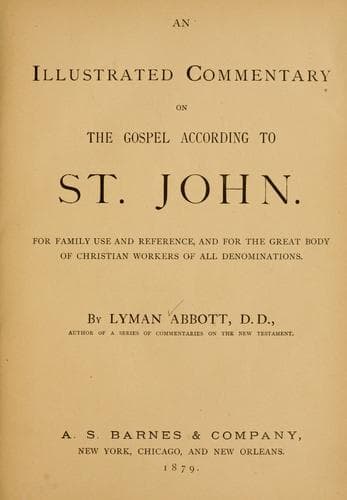
An illustrated commentary on the Gospel according to St. JohnAbbott, Lyman
Religion
An illustrated commentary on the Gospel according to St. John
Abbott, Lyman
Bible. John -- Commentaries
=28, 29. Then Jesus cried aloud teaching in the temple, and said, Ye
do indeed know me, and ye know whence I am; and I am not come of
myself, but it is the True One who hath sent me; him ye do not know. I
know him, for I have come from him, and he it is that hath sent me
forth.= As I read it, this is one of those outbursts of indignation
with which we occasionally meet in the teachings of Christ. The
obduracy and resoluteness in evil of the Jews aroused his indignation
and elicited his stern rebuke. Comp. chaps. 8:41, 44; 9:41; Matthew,
ch. 23. I understand then his language to be neither ironical nor
interrogative, but affirmative, and not to refer to his human nature
and origin, but to his divine character and mission. In his miracles
and his instructions they had seen and heard enough to assure them
that he was from God (chaps. 3:2; 11:47, 48). Their contemptuous
declaration, _We know this fellow_, he transformed into an indictment
against them. They had whispered it; he proclaimed it aloud. “Ye do
know me,” he says, “and ye know whence I am, for the authentication of
my divine mission is ample. Ye do know that I am not come of myself,
for my whole life is a conclusive demonstration that I am not a
self-seeker.” The _True One_ is not equivalent to the Truthful One nor
the Really Existent One merely, but the One True God (2 Chron. 15:3;
Jer. 10:10; John 17:3; 1 Thess. 1:9; 1 John 5:20). Him they did not
and could not know, because the knowledge of God is only for the pure
in heart (Matt. 5:8). Jesus knew him, for he had been his companion
from eternity. In a sense we are all from God, but not in the sense in
which Christ here indicates that he is from God. The preposition used
(παρά) has the sense of _from beside, from near_, French _de chez_
(_Rob. Lex._). The declaration is interpreted by ch. 1:1; Phil. 2:6.
The public exposure of their whispered contempt, the equally public
exposure of the secret thought of their own hearts, which they had not
themselves read as clearly as Christ read it for them, and the tone of
fearless assumption in which he at once claimed to be the companion of
the Only True God and declared that they did not even know Him, whose
peculiar people it was their peculiar boast to be, angered the
Judeans, and especially the hierarchy, and led to the unsuccessful
attempt to arrest Jesus recorded in the succeeding verse.
30 Then[285] they sought to take him: but no man laid hands
on him, because his hour was not yet come.
[285] ch. 8:37; Mark 11:18; Luke 20:19.
31 And many[286] of the people believed on him, and said,
When Christ cometh, will he do more miracles than these
which this _man_ hath done?
[286] ch. 4:39.
Public-domain text, read in full here on John Shaqi.
Reviews
Reviews
No reviews yet
Be the first to share your thoughts on this work.
Elsewhere in the archive
Join the Discussion
Join the discussion
Sign in to leave a comment or review.
Sign InorCreate an account