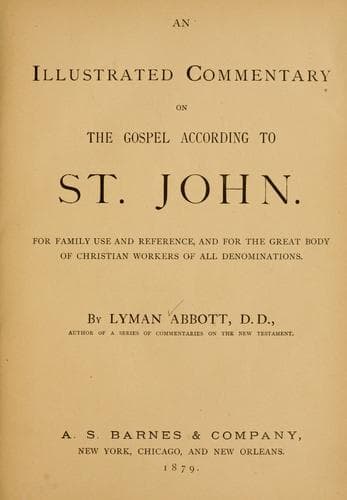
An illustrated commentary on the Gospel according to St. JohnAbbott, Lyman
Religion
An illustrated commentary on the Gospel according to St. John
Abbott, Lyman
Bible. John -- Commentaries
=32-34. The Pharisees and the chief priests sent officers to take
him.= This was an official act on the part of the Sanhedrim or its
officers, carrying out the design of certain of the people, as
indicated in ver. 30; and it is the first official endeavor to arrest
him, the beginning of a course of action consummated in his final
arrest, trial, and crucifixion.--=Therefore said Jesus unto them.= A
break evidently occurs between verses 31 and 32. The discourse up to
ver. 31 is continuous, and took place about the middle of the feast,
that is, the third or fourth day; the discourse in verses 37-39 was on
the last day of the feast; between the two the orders for Christ’s
arrest were given. Verses 33, 34 are founded on Christ’s knowledge of
those orders, and it is a reasonable surmise that the presence of the
officers suggested it to him and interpreted its meaning to some at
least of his auditors.--=Yet a little while am I with you.= About six
months after this address he was crucified.--=And I go unto him that
sent me.= With this explicit statement of his meaning, interpreted as
it was by the previous declaration that it was the true God who had
sent him, it is difficult to understand how the Jews could have been
perplexed respecting his meaning. De Wette’s explanation that they
knew not the One who had sent him, and therefore that this saying was
a dark one to them, is not wholly satisfactory, for surely they did
know who was meant by the phrase, _he that sent me_, and as surely
they could not fail to understand that going to God was equivalent to
death. Meyer supposes that the words _him that sent me_ in this verse
were not a part of Christ’s discourse, but added, perhaps by John
himself; but they are not wanting in any of the manuscripts; and that
is both a doubtful and a dangerous kind of criticism which removes a
difficulty by the summary process of removing the difficult words,
without any external authority for so doing. I believe therefore that
Christ was explicit, that he was understood, and that the assumed
perplexity of his hearers was a piece of hypocrisy. See on verses 35,
36.--=Ye shall seek and shall not find me; and where I am ye cannot
come.= The key to the true interpretation of this passage, is afforded
by Luke 17:22; John 8:21; 13:33. Christ does not refer to an inimical
seeking; the _search_ here is the same as the _desire_ to see one of
the days of the Son of man in Luke 17:22; _i. e._ the Jewish desire
for a manifestation of the Messiah. He does not refer to a true
spiritual seeking, for in ch. 8:21 he declares, to the same Jewish
auditors, _Ye shall seek me and ye shall die in your sins_. Eusebius
declares that many Jews in consequence of the judgments of God on
Jerusalem became believers; such did indeed seek Christ, but they
found him. The meaning then is that in the coming days of travail and
sorrow, when many should go out after false Christs (Matt. 24:23, 24),
Public-domain text, read in full here on John Shaqi.
Reviews
Reviews
No reviews yet
Be the first to share your thoughts on this work.
Elsewhere in the archive
Join the Discussion
Join the discussion
Sign in to leave a comment or review.
Sign InorCreate an account