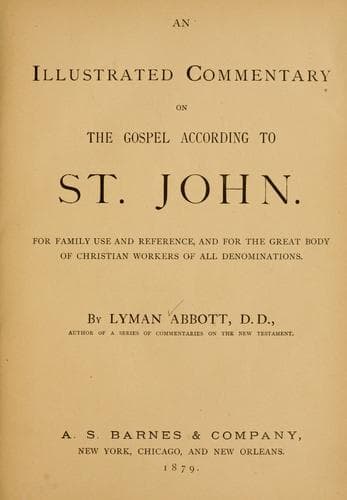
An illustrated commentary on the Gospel according to St. JohnAbbott, Lyman
Religion
An illustrated commentary on the Gospel according to St. John
Abbott, Lyman
Bible. John -- Commentaries
the Jews would earnestly desire a Messiah for their deliverer, whom,
however, they could not have, because with their own hands they had
put him to death. They would seek, but theirs would be a temporal, not
a spiritual seeking; the seeking of fear and self-interest, not of
repentance, faith, and love. This verse affords no authority whatever
for the opinion that any earnest spiritual soul ever seeks Christ in
vain.
35 Then said the Jews among themselves, Whither will he
go, that we shall not find him? will he go unto the
dispersed[289] among the Gentiles, and teach the Gentiles?
[289] Isa. 11:12; James 1:1; 1 Pet. 1:1.
36 What _manner of_ saying is this that he said, Ye shall
seek me, and shall not find _me_; and where I am, _thither_
ye cannot come?
=35, 36. Then said the Jews among themselves.= Their utterance has
been by some regarded as the utterance of a genuine perplexity. So
apparently Maurice: “He had broken down the barriers between different
classes of Israelites--between Galileans, Samaritans, and Jews. Why
might he not carry his designs further? Why might he not go to the
dispersed tribes in heathen lands? Why might he not preach to the
heathen themselves?” By others it is regarded as the language of scorn
and contempt. So Meyer: “An insolent and scornful supposition, which
they themselves, however, do not deem probable (therefore the question
is asked with μή), regarding the meaning of words to them so utterly
enigmatical. The bolder mode of teaching adopted by Jesus, his
universalistic declarations, his partial non-observance of the law of
the Sabbath, would lead them, perhaps, to associate with the
unintelligible statement a mocking thought like this, and all the more
because much interest was felt among the heathen, partly of an earnest
kind, and partly (comp. St. Paul in Athens) arising from curiosity
merely, regarding the Oriental religions, especially Judaism.” The
latter view seems to me the more probable, because (1) it is
inconceivable that the Jews should have misapprehended Christ’s
meaning (ver. 33, note); (2) his analogous language in the next
chapter they clearly did understand to refer to his death (ch. 8:22);
(3) the fact that what was said was “among themselves” indicates that
it was not an honest perplexity, in which case they would have asked
Christ for an explanation, but of the same quality as the murmuring
reported in verses 26, 27.
37 In the last[290] day, that great _day_ of the feast,
Jesus stood and cried, saying, If[291] any man thirst, let
him come unto me, and drink.
[290] Lev. 23:36.
[291] Isa. 55:1; Rev. 22:17.
Public-domain text, read in full here on John Shaqi.
Reviews
Reviews
No reviews yet
Be the first to share your thoughts on this work.
Elsewhere in the archive
Join the Discussion
Join the discussion
Sign in to leave a comment or review.
Sign InorCreate an account