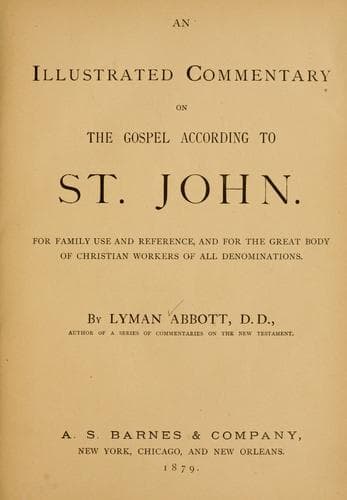
An illustrated commentary on the Gospel according to St. JohnAbbott, Lyman
Religion
An illustrated commentary on the Gospel according to St. John
Abbott, Lyman
Bible. John -- Commentaries
=37. In the last day, that great day of the feast.= The feast of the
Tabernacles proper lasted for seven days (Lev. 23:34, 41, 42), but on
the eighth day a solemn assembly kept as a feast-Sabbath was directed
to be held (Lev. 23:36; Numb. 29:35; Neh. 8:18); and though the people
dwelt in the booths only the seven days, this eighth day was reckoned
by the Jews as a part of the feast. Whether the seventh or the eighth
is intended here by the “last day of the feast” is a little uncertain,
as it also is whether the drawing of water from the brook Siloah,
which was a characteristic ceremonial of the other days of the feast,
took place also on the eighth day. This ceremonial recalled the
miraculous supply of water in the wilderness from the riven rock; it
was connected by the more superstitious of the people with the notion
that at this time God determined the amount of rain which should fall
during the year; and the more spiritual saw in it a symbol of the time
when the promised gift of the Holy Spirit should be bestowed upon
Israel (Isa. 12:3). Whether the words of Christ were uttered, as Dr.
Geikie supposes, during this ceremonial, or, as Alford supposes, the
day after this service had come to an end, the reference to it is
unmistakable. Dr. Geikie’s supposition certainly makes this reference
more striking, and gives, if not peculiar significance, at least
peculiar force, to Christ’s words. “The last day of the feast, known
as ‘the Hosanna Rabba’ and the ‘Great Day,’ found him, as each day
before, doubtless, had done, in the temple arcades. He had gone
thither early, to meet the crowds assembled for morning prayer. It was
a day of special rejoicing. A great procession of pilgrims marched
seven times round the city, with their lulabs, music, and loud-voiced
choirs preceding, and the air was rent with shouts of Hosanna, in
commemoration of the taking of Jericho, the first city in the Holy
Land that fell into the hands of their fathers. Other multitudes
streamed to the brook of Siloah, after the priests and Levites,
bearing the golden vessels with which to draw some of the water. As
many as could get near the stream drank of it amidst loud shouting of
the words of Isaiah--‘Ho, every one that thirsteth, come ye to the
waters,’ ‘With joy shall we draw water from the wells of
salvation’--rising in jubilant chants on every side. The water drawn
by the priests was, meanwhile, borne up to the temple, amidst the
boundless excitement of a vast throng. Such a crowd was, apparently,
passing at this moment. Rising as the throng went by, his spirit was
moved at such honest enthusiasm, yet saddened at the moral decay which
mistook a mere ceremony for religion. It was burning autumn weather,
when the sun had for months shone in a cloudless sky, and the early
rains were longed for as the monsoons in India after the summer heat.
Water at all times is a magic word in a sultry climate like Palestine,
but at this moment it had a double power.
Public-domain text, read in full here on John Shaqi.
Reviews
Reviews
No reviews yet
Be the first to share your thoughts on this work.
Elsewhere in the archive
Join the Discussion
Join the discussion
Sign in to leave a comment or review.
Sign InorCreate an account