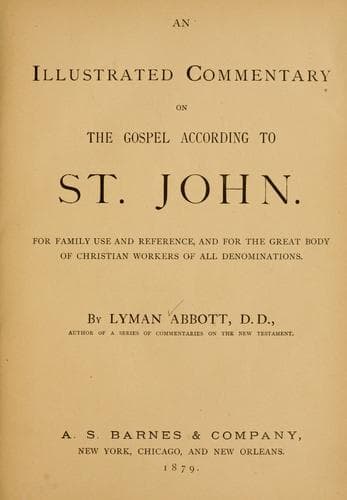
An illustrated commentary on the Gospel according to St. JohnAbbott, Lyman
Religion
An illustrated commentary on the Gospel according to St. John
Abbott, Lyman
Bible. John -- Commentaries
=45, 46. Then came the officers.= Not Roman soldiers, but temple
police, answering to the modern constable or the Roman lictor or the
English beadle. They had been directed by the officers of the
Sanhedrim to arrest Jesus (ver. 32). Presumptively this return of the
officers occurred several days after their commission to make the
arrest. They had been watching him during the feast.--=Never man spake
like this man.= They were not overawed by the multitude, but by the
words of Christ himself. There is no stronger testimony, even in the
Gospels, to the marvellous moral power of Christ’s personality and
words than this declaration of the temple police, who were probably
ignorant but also simple men, without the culture, but also without
the religious prejudices, of the rulers. In the life of Whitefield are
several illustrations of analogous moral power over roughs who had
come to the preaching to break it up, but who remained spell-bound
under its influence. To have elicited such testimony as this from such
men as these, Jesus must have possessed the power of a true oratory.
47 Then answered them the Pharisees, Are ye also deceived?
48 Have any of the rulers[301] or of the Pharisees believed
on him?
[301] ch. 12:42; Jer. 5:4, 5; 1 Cor. 1:26.
49 But this people, who knoweth not the law, are cursed.
=47-49.= The language of the Pharisaic rulers is that of unbounded
scorn for Jesus and for the multitude. The latter are declared to be
under divine wrath and cursed with moral blindness because they have
an admiration for such a Sabbath-breaker. “All here is wonderfully
living and characteristic. The faint effort of the officers to execute
the command of their masters; the awe which held them back; their
simple confession of the power which they found in the words of Jesus;
the surprise of the Sanhedrim that the infection should have reached
even their servants; their terror lest there might be traitors in the
camp, lest any Pharisee or lawyer (probably some eyes were turned on
Nicodemus) should have been carried away by the impulse to which the
crowd, naturally enough, had yielded; their scorn of the people, as
wretched, ‘accursed’ men, utterly ignorant of the law--who does not
feel as if he were present in that convocation of doctors? as if he
were looking at their perplexed and angry faces? as if he were hearing
their contemptuous words?”--(_Maurice._)
50 Nicodemus saith unto them, (he[302] that came to Jesus
by night, being one of them,)
[302] ch. 3:2.
51 Doth[303] our law judge _any_ man before it hear him,
and know what he doeth?
[303] Deut. 17:8; Prov. 18:13.
52 They answered and said unto him, Art thou also of
Galilee? Search and look: for out of Galilee[304] ariseth
no prophet.
[304] Isa. 9:1, 2.
Public-domain text, read in full here on John Shaqi.
Reviews
Reviews
No reviews yet
Be the first to share your thoughts on this work.
Elsewhere in the archive
Join the Discussion
Join the discussion
Sign in to leave a comment or review.
Sign InorCreate an account