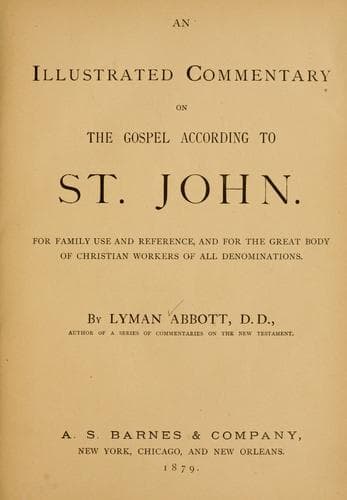
An illustrated commentary on the Gospel according to St. JohnAbbott, Lyman
Religion
An illustrated commentary on the Gospel according to St. John
Abbott, Lyman
Bible. John -- Commentaries
=50-52.= On the character of Nicodemus, see notes on ch. 3. The
impression which Jesus had made upon him in that interview was an
abiding one. There is a covert sarcasm in his question here, _Doth our
law judge the man except it first hear him and know what he doeth?_
They themselves knew not the law, and were openly disregarding it. The
Rabbinical laws explicitly required that every accused person should
have a hearing, with an opportunity to confront the witnesses against
him and to cross-examine them. See Vol. I, p. 298. That Nicodemus’
rebuke was felt by the Pharisees is shown by the tone of their answer.
They replied, not by argument, but by a sneer, _Art thou also of
Galilee?_ and by a falsehood, _Out of Galilee hath arisen_ (perfect,
not present) _no prophet_. Jonah was of Galilee (2 Kings 14:25),
Elijah very probably so (1 Kings 17:1;--_Alford_), and Nahum either of
Galilee or of Assyria, a heathen land (Nahum 1:1). The prejudices of
the Pharisees led them to forget their history as well as their law.
In lieu of _doth our law judge any man?_ read _the man_, _i. e._, this
man; Nicodemus refers specifically to Jesus. In lieu of _ariseth_ read
_hath arisen_; though there is some uncertainty. Alford gives the
present tense, _ariseth_; Lachmann, Tischendorf, and Meyer, with
greater probability, the past tense, _hath arisen_. With either
reading the meaning is substantially the same; not, as Godet, The
promised prophet is not now arising, but, as Meyer and Alford, No
prophet ever ariseth from Galilee.
53 And every man went unto his own house.
=53.= This verse belongs with the next chapter.
CHAPTER VIII.
Ch. 7:53 to 8:11. THE WOMAN TAKEN IN ADULTERY.--ILLUSTRATES: THE TACT
OF CHRIST--THE PRECEPT, JUDGE NOT, THAT YE BE NOT JUDGED--THE POWER OF
CONSCIENCE--THE CHRISTIAN TREATMENT OF THE FALLEN.
PRELIMINARY NOTE.--Verse 53 of ch. 7 belongs unquestionably with the
first eleven verses of ch. 8. Whether the whole passage is really a
part of John’s Gospel or no is one of the most difficult and doubtful
questions in Biblical criticism. The weight of critical authority is
against it; the weight of internal evidence is in its favor. For a
complete discussion of the considerations _pro_ and _con_, the student
must be referred to the commentaries of Alford, Meyer, Luthardt,
and Godet, the last being, of the three, the most comprehensive in
its treatment. Here I give briefly (1) the facts, (2) the different
opinions, (3) my own conclusion.
Public-domain text, read in full here on John Shaqi.
Reviews
Reviews
No reviews yet
Be the first to share your thoughts on this work.
Elsewhere in the archive
Join the Discussion
Join the discussion
Sign in to leave a comment or review.
Sign InorCreate an account